Sharing and comparing land use strategies across the UK
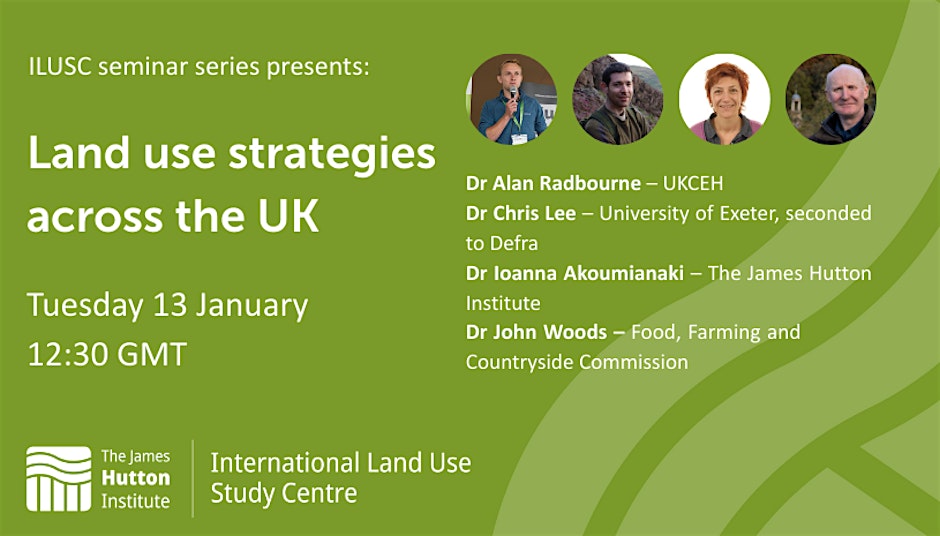
On 13th January Lee-Ann Sutherland and I hosted our first ‘ILUSC’ webinar, on Land Use Strategies across the UK. Thinking strategically about the priorities we have for our land is important given the many demands and oft-competing objectives places on landscapes; but doing so is something relatively new for the UK.
We are enormously grateful to our 4 expert speakers who deftly summarised the situation in Wales, Northern Ireland, Scotland and England. This can’t have been an easy thing to summarise so concisely, because – as we learnt – both the existing governance of land use and new policies for land use strategies are evolving in quite different ways across the UK.
Some of the differences are obvious – for example, in Scotland we have been working on this for longer, and are now approaching the fourth 5-year land use strategy; whereas England is just getting started. Other differences were more subtle: for example, there was an interesting note about the pros and cons of working in a relatively large department such as Defra, versus smaller but cross-connected administrations elsewhere in the UK.
In all cases, it was striking that work to develop strategies is focused on the procedural – e.g. what principles and steps should be entailed in making land use strategies – rather than prescribing what specific objectives or goals should result. In Scotland there have also been trials of regional land use frameworks, creating regionally specific priorities. Setting up principled and well-designed processes is essential if the processes and outcomes are to be recognised as setting priorities for land use that fairly reflect a balance of interests and needs across society.
I do have a worry that however well designed these processes are, by themselves they will not have much influence over land use and landscapes, if they lack ‘levers’ of influence or meaningful connections into other policies or sectors. For example, the schemes and subsidies available to land managers under agricultural policies can have a big influence on some land manager decision-making; so land use strategies may have little influence over agricultural land if they cannot influence or connect with these schemes. I would be happy to have my worries allayed though! It will be interesting and important to track how policy making over land evolves across the UK over the next few years – perhaps we shall have to reconvene this discussion in a couple of years’ time!
You can catch up on the webinar here.
We plan for this to be the first in a series, and the next one will be on fostering collaboration across landscapes, likely in late March – watch this space for more details!
Disclaimer: The views expressed in this blog post are the views of the author, and not an official position of the institute or funder.