Research from The James Hutton Institute and The University of Dundee reveals how barley protects itself
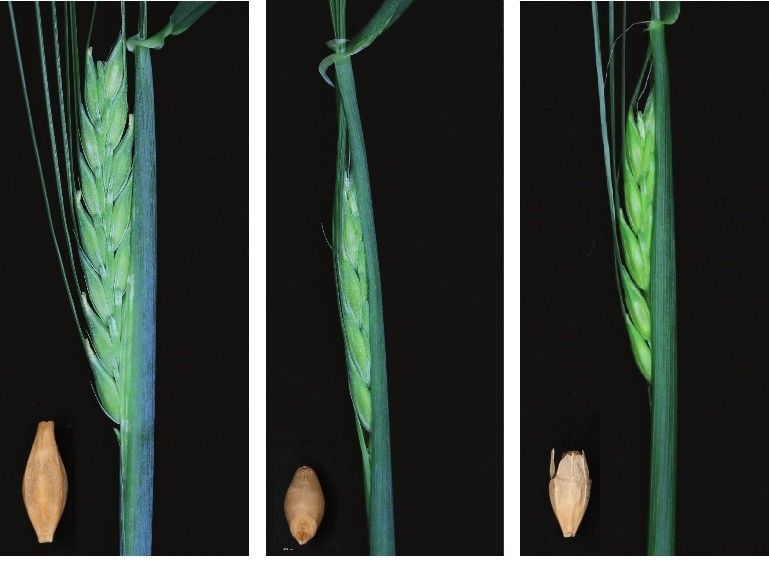
Panel on left shows barley with a typical wax bloom and covered grain. The middle and right panels show how defects in the HvBODYGUARD (BGD) and Wax- Inducer1 (HvWIN1) genes respectively lead to a loss of wax bloom and skinned grain
A study from the International Barley Hub (IBH), published in New Phytologist, identifies the genetic mechanisms behind specialised surface features that help barley withstand environmental stress and maintain grain quality.
The IBH, part of a £62m investment through the Tay Cities Region Deal (TRCD) a partnership between local, Scottish and UK governments and the private, academic and voluntary sectors, promotes scientific discovery and innovation to future-proof barley, the predominant crop grown in Scotland.
Dr Sarah McKim, Deputy Director of the IBH, Reader at Faculty of Life Sciences at the University of Dundee, and corresponding author of the study, explained that plant surfaces are typically coated with a waxy, waterproof barrier, known as the cuticle, which protects tissues from water loss, ultraviolet radiation and pest attack. Some plants are known to develop highly specialised versions of this protective layer.
She said, “Our research examined two distinctive cuticular adaptations which barley evolved: a ‘wax bloom’ that appears on elongating tissues during flowering and is also observed in wheat and a surface that tightly adheres to the grain husk, forming a protective covering essential for grain quality.”

Dr Sarah McKim
This study found two key genes – BODYGUARD (BGD) and WAX-INDUCER1 (WIN1) – control these traits. When either gene is defective, barley loses both features, leading to grain skinning, a condition where the protective husk becomes detached from the grain, which is a major concern for the malting industry, the most valuable end use of barley.
These discoveries have wider implications as these protective layers help prevent water loss, offering potential routes to improve drought tolerance in cereal crops.
This research, which was carried out in collaboration with the University of Dundee and the National Institute of Agricultural Botany (NIAB), relied on powerful modern tools that let scientists read and compare DNA and RNA (ribonucleic acid, which plays a key role in helping cells use genetic information), identify genetic differences, map genomes, and determine which genes are active in which tissues.
It was primarily funded by the Biotechnology and Biological Sciences ResearchCouncil(BBSRC), with additional support from Scottish Government, alongside numerous PhD and summer student scholarships.
