SOAR
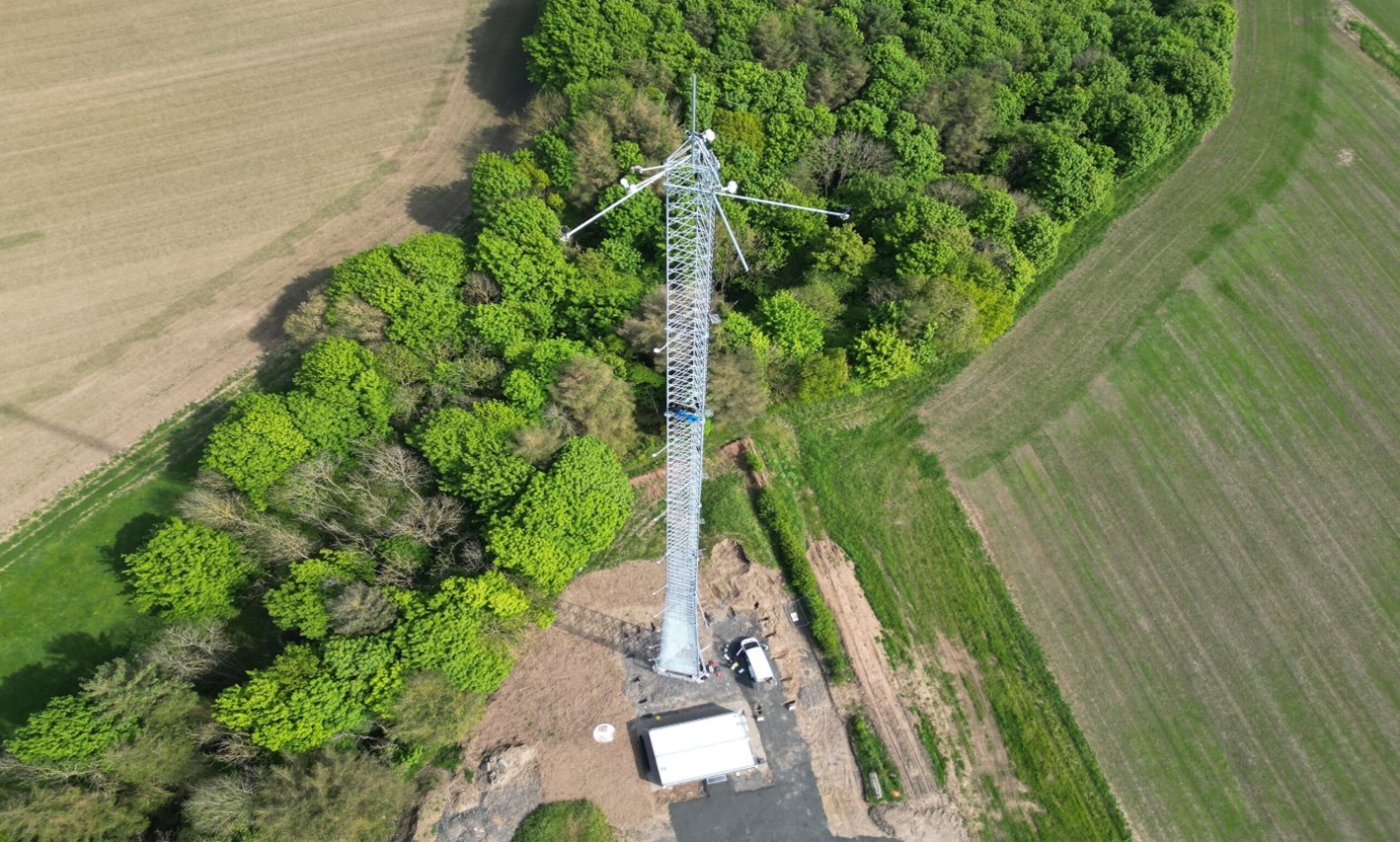
The Scottish Observatory for Atmospheric Research (SOAR) is the UK’s first purpose-built tall tower dedicated to atmospheric science. Standing 100 metres tall at The James Hutton Institute’s Balruddery campus near Dundee, it is transforming how scientists measure greenhouse gases, air pollutants and other atmospheric trace gases, providing vital evidence to support climate action in Scotland and beyond.
Jointly owned by the Hutton and the University of Edinburgh, SOAR was funded through a UK Research and Innovation (UKRI) award secured by the University of Edinburgh. Completed in 2025, the facility is now fully operational and supports collaborations with organisations including the National Physical Laboratory (NPL) and the University of Bristol, which host specialist monitoring equipment within the site’s laboratory facilities.
Understanding greenhouse gas emissions
SOAR has been designed to deliver highly accurate measurements of greenhouse gases, including carbon dioxide (CO₂), methane (CH₄) and nitrous oxide (N₂O). By continuously sampling air at heights of 50m and 100m, the observatory provides detailed, real-time information about where emissions originate and how they change over time.
Traditionally, national greenhouse gas estimates rely on “bottom-up” calculations based on activity data and modelling. While essential, these approaches can carry significant uncertainties. SOAR provides an independent source of atmospheric measurements that can be used to verify and improve emissions estimates, increasing confidence in the data used to inform climate policy and decision-making.
Supporting Scotland’s Net Zero ambitions
Scotland has committed to reaching net zero greenhouse gas emissions by 2045. Achieving this goal requires accurate, reliable evidence about emissions and how they are changing.
SOAR makes a major contribution to this effort by providing atmospheric observations that can be compared with reported emissions data. This helps researchers, policymakers and governments better understand the effectiveness of climate interventions and identify where further action is needed. Depending on prevailing wind conditions, SOAR can sample air masses arriving from the North Atlantic, across northern Britain and from continental Europe. These measurements are already improving our understanding of regional greenhouse gas emissions and atmospheric processes.
Project contact:
Team members
Part of an international climate monitoring network
SOAR is part of a growing international network of atmospheric observatories that support countries in monitoring and understanding their greenhouse gas emissions under the framework of the Paris Agreement.
The facility also creates opportunities to work alongside other Scottish environmental monitoring initiatives, including the Scottish Land LiDAR Programme, which is developing a high-resolution three-dimensional map of Scotland’s landscapes. Together, these investments strengthen the country’s capability in environmental monitoring, reporting and verification.
A resource for climate and environmental research
SOAR forms part of the Hutton’s response to the climate and nature crises. The facility complements the Institute’s research into sustainable land use, agriculture, natural resource management and environmental change.
By improving understanding of greenhouse gas emissions from peatlands, forestry, agricultural systems and other land-based sectors, SOAR will help researchers develop climate-smart land management and farming practices. The observatory provides the evidence needed to better assess Scotland’s carbon footprint and supports efforts to deliver measurable progress towards climate goals.
Funding and partnership
SOAR was supported by a £996,000 Natural Environment Research Council (NERC) capital grant awarded in 2021, with the University of Edinburgh acting as grant holder. Funding supported the construction of the tower and the installation of specialist scientific equipment.
The facility has since attracted further investment through national programmes focused on emissions monitoring and environmental observation, strengthening its role as a key component of the UK’s climate research infrastructure.