Envisioning the Isle of Coll’s future: what role for housing?

Where do we expect Coll to be in 2045 if current economic and policy trends continue? And what would we like to see happen? How can housing interventions contribute to moving from the most likely to the most desirable scenario? These are questions that the Isle of Coll community discussed in a workshop organised by researchers from The James Hutton Institute’s Social, Economic & Geographical Sciences department as part of the Scottish Government-funded project “Informing a socially and spatially just future for the Scottish rural economy: Pinpointing opportunities, assets and support needs”.
The promotion of a more evenly distributed population is a key goal of the Scottish Government’s 2021 National Population Strategy, and the revised National Islands Plan (2026) has “population retention and attraction” as its central objective. The Isles of Coll and Tiree have been identified as a “repopulation zone” in Argyll and Bute, but for them to thrive as places, many complex, interrelated challenges must be addressed. Previous Hutton research has identified rural housing as a key issue and a leverage point.
Building likely and desirable scenarios.
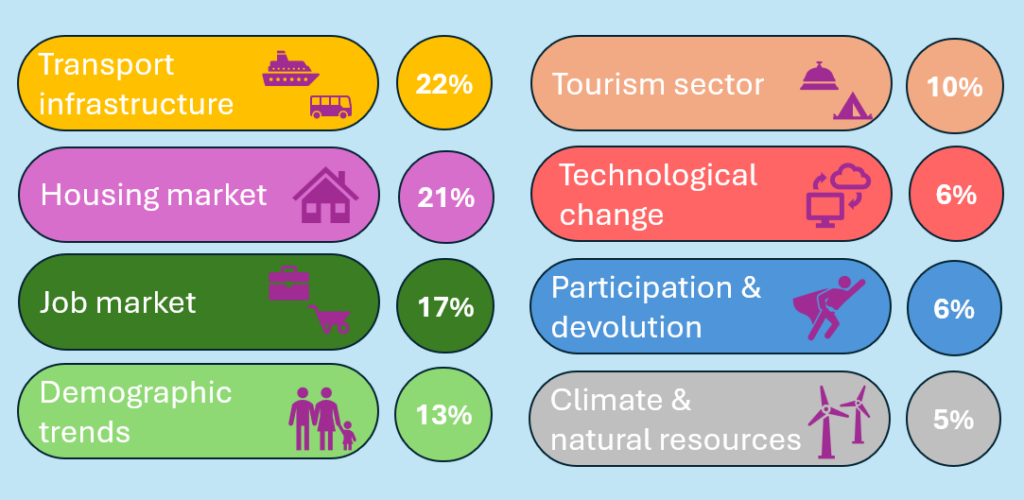
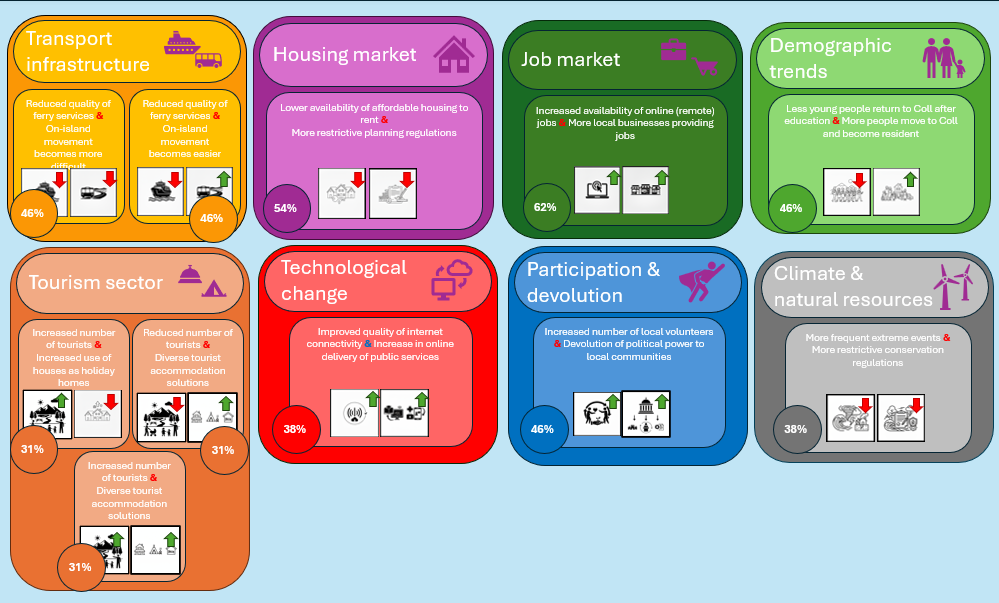
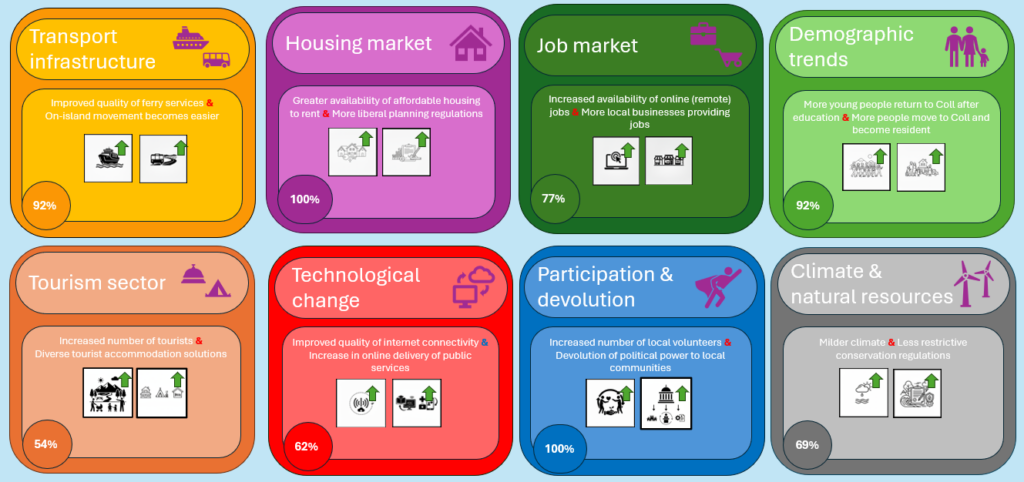
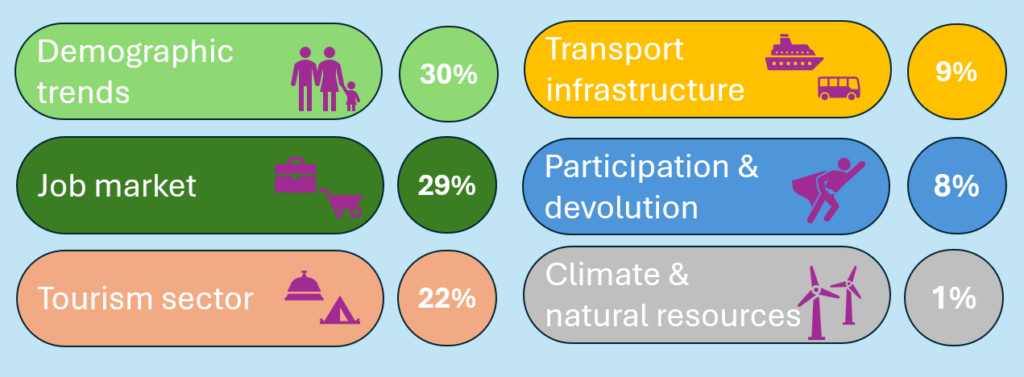
Over two days, Coll’s residents first contributed to developing a timeline of local housing from 1945 to the future, which identified key events and factors affecting housing on the island. Then, using an adapted version of the scenario approach designed in the European project RELOCAL, islanders co-created a business-as-usual and an aspirational scenario for their island. These scenarios were created using eight drivers of change affecting rural Scotland as a whole, identified from a review carried out by Hutton researchers in 2025. Ahead of the workshop, the drivers were adapted to the local context using the priorities of the Community Council’s Local Place Plan. Workshop participants were first asked to vote on the relevance of each driver for the future of Coll, followed by two votes on the most likely direction of each driver, and the most desirable one. To conclude, community members reflected on which drivers were related to housing conditions, and whether their direction could be impacted by interventions in this field. The results of these votes are illustrated in the images below.
Coll’s housing timeline.
Twelve people – out of 176 residents – contributed to the housing timeline, covering different age groups, genders, and housing situations. We discovered that Coll had had two large landowners during the second half of the Twentieth Century: “the laird,” and the “Dutchman,” an investor whose policy was not to develop any housing on their property. During the same period, traditional houses were upgraded with water, heating, and electricity; social housing was built and then in part privatised through help-to-buy schemes; and the Project Trust – a local charity – developed housing for their staff, now used by other residents. The large estates have now gone, with various private landowners restructuring the buildings that once belonged to them, and the RSPB owning much of their land, which is devoted to nature conservation.
More recently, the inflow of money from second-home buyers living off-island has caused a rise in housing prices beyond the purchasing power of residents with local jobs, but the infrastructure (roads, servicing) has not kept pace with this growth. For instance, the lack of mains water outside the only village – Arinagour – represents a key constraint to housing development. Additionally, many of the houses purchased by non-residents are used as seasonal holiday homes or for short-term lets. We learned that around 75 of the available houses are permanently occupied, and around 70 are only temporarily occupied. The Argyll and Bute Housing Association is currently planning to build around 10 new social houses.
A likely scenario for Coll.
“Is it about housing, or about jobs?” This question, posed at the very start of the workshop by a participant, helps us move to the second day’s activity, when 13 residents co-developed business-as-usual and desirable scenarios for their island. While the housing market plays a key role, the future of Coll as a place will result from the complex interaction of many drivers of change. According to workshop participants (Figure 1), transport – in particular, ferry services and air transport (with on-island transport mentioned less frequently) – is the most important driver of change, closely followed by the housing market, the job market and, at some distance, demographic trends, and the tourist sector. Technological change, devolution and participation patterns, as well as climate change and resource use regulations, were deemed less impactful.
For some drivers, there was a stronger consensus on their future direction. For instance, the job market was expected to evolve towards an increased number of remote jobs and of local businesses providing more employment, while the housing market would likely see lower availability of affordable housing to rent, and more restrictive planning regulations. Other drivers were more difficult to predict: while more people were expected to move to Coll and become residents, participants were divided on whether more young people would return to the island after secondary education – with the lack of educational opportunities linked to the local economy being a key driver of outmigration. And while almost everyone agreed that the quality of ferry services will decline, participants could not agree on the future of on-island road infrastructure. Some pointed out that a direct flight to Glasgow, and improved transport links with Tiree would have a clear and positive impact on the local economy. Other drivers, for example, the tourist sector, showed even more uncertainty.
A desirable scenario for Coll.
However, workshop participants agreed strongly on where they would like Coll to be in twenty years, favouring an improved quality of ferry services and on-island transport; greater availability of affordable housing to rent and less restrictive planning regulations; more young people returning to Coll after education, along with more new residents; and a more vibrant volunteering sector, together with the devolution of political power to local communities – as long as the combination of the latter two trends does not lead to too much strain on local people. Only the tourist sector and the patterns of technological change raised contrasting views. While everyone wanted to see more diversified tourist accommodation solutions beyond holiday homes, there were different opinions on whether tourist numbers should increase or decline. Equally, while most participants looked forward to improved internet connectivity and increased online delivery of public services, some argued that the latter could be a double-edged sword if online delivery were to replace in-person provision.
What role for housing?
Unsurprisingly, a last vote showed that the future direction of many of these drivers will be strongly related to housing dynamics – primarily demographic trends, the job market, and the tourist sector, but also transport, and participation (Figure 4). The availability of affordable housing would increase the number of people who can live on Coll, and thus the resilience of local services and the local economy. The final discussion suggested that a restriction on short-term tourist lets could help avoid more homes moving from full occupancy to the holiday or second home sectors, but would be difficult to police. And while some social housing is being built, there is uncertainty regarding how it is allocated, with the current point system causing a mismatch between the skills required for supporting a viable community, and those brought by new residents. This adds to the more general challenge of attracting people to Coll. The current housing stock was also perceived as problematic due to the lack of flats or shared housing. Finally, regarding the location of housing, increasing concentration in Arinagour leaves people living outside the village without close access to support networks. Specific employee support and clear planning guidance from the Argyll and Bute Council, or a national planning law on holiday home conversion could contribute to addressing these challenges.
Despite persisting challenges, the scenario-building process revealed that islanders remain optimistic concerning the future of their community, in stark contrast to narratives about inevitable depopulation and decline of Scotland’s rural and island areas. This is shown, for instance, by the positive outlook for the job market. Nevertheless, public services, transport, and housing represent ongoing challenges, calling for more actions to support the island community.
Blog by Simone Piras, Jonathan Hopkins, Jack Rendall and Sophie Miller
Disclaimer: The views expressed in this blog post are the views of the author, and not an official position of the Hutton or funder.