How sustainable is the Hutton?
When looking at The James Hutton Institute’s website, words and phrases like sustainable land management, nature crisis, natural resources, positive change, and thriving communities can be found everywhere, alongside mentions of our world class facilities, and state of the art laboratories or field stations. In 2024 we won the Kings Anniversary Award for Sustainability based on how our research and climate action plan was doing, but how are we building on this?
It doesn’t take long to realise that the Hutton is a purpose-driven organisation, aiming to reduce the impact of agriculture on the environment, ensuring agriculture is adaptable to a changing climate as well as exploring how communities can be supported. This becomes even more strikingly obvious when looking at the three research themes.
- Connecting land and people
- Improving crop resilience and sustainability
- Protecting and enhancing natural capital
The interdisciplinary work done at the Hutton also highlights that everything is connected in nature and everything has an impact on the environment. While planting trees is a go-to solution to sequester emissions, the planting itself initially causes emissions, and viability depends on a lot of factors. Similarly, while the Hutton aims to reduce environmental impacts on the environment, the research and operations themselves have an impact. The electricity consumed in laboratories or growing facilities, the fuel needed at farms, the commuting and business travel, the procurement of goods and services or the day to day running of five sites with more than 35 buildings and over 500 employees have an impact.
The Hutton is aware of its impact and began reporting its emissions in 2014/15. Since that first report, it has greatly increased the emission sources included.
From 2019/20 Hutton has measured and reported emissions under all scopes as well as published its first emission reduction plan, which went on to become a Climate Action Plan, with net zero emission targets for all scopes.
Progress so far
The Hutton baselined emissions in 2019/20 at 16,450 tCO2e. This is equivalent to driving 2,300 petrol cars for one year (7,000km per year per car) or the energy it takes to power 2,300 UK homes for one year. It is considerably more than the average workplace in the UK, when looking at emissions per employee, so where do these emissions come from?

The biggest proportion of Hutton emissions come from procurement, which accounts for 60% of emissions, followed by energy use, farms and travel.
Though it is difficult to reduce indirect emissions such as procurement, it is important to work with suppliers to get a better understanding of the impact of products we buy.
While we do that, we continue also to reduce emissions over which we have more influence. The construction of Buillionfield Solar Meadow, air source heat pumps at Invergowrie, the ongoing rollout of LEDs and campaigns helped reduce our energy consumption.
The work with suppliers showed that products we buy are actually more locally produced than we thought, which lowers products emissions. Travel emissions reduced considerably, and while lockdowns had a big impact, a lot of the reductions have remained and emissions are still decreasing.
The last years saw additional construction emissions through the Tayside Cities Region Deal (TCRD), Hydroglen and Just Transition developments, but for most parts we managed to stay on target with our emissions.
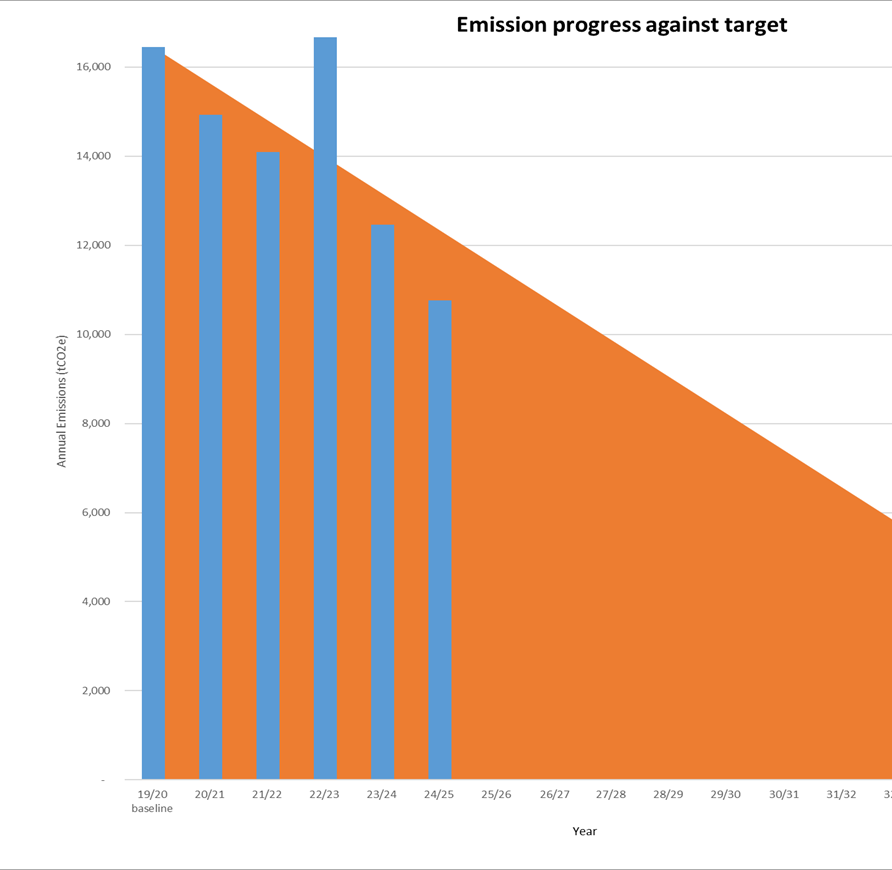
With the exception of 2022/23, since baselining our emissions in 2019/20, we consistently achieved and exceeded our annual target emissions reduction. The emission increase in 2022/23 was a result of increased procurement emissions due to higher spending. Since then, we improved embedded emissions data of high value products by getting data directly from suppliers. This means we don’t fully rely on our spending anymore to calculate emissions, making emissions data more accurate.
Emissions in 2024/25 are already below the target of 2025/26.
We have also made up for the excess emissions in 2022/23 and are below budget.
So far, we have reduced our total emissions by 35% since establishing our baseline, exceeding the target reduction of 25%.
Where are these emission reductions coming from?
Better data? Reduction in consumption?
Both of these! As procurement was the largest proportion of emissions and the data had the biggest uncertainty attached, this is the area that shows the biggest reduction in emissions. Procurement emissions have reduced by about 60%, which is a direct result of better data. In future we hope to use the data collated to make more informed decisions when procuring.
We also achieved strong emission reductions in areas under our direct control. For example, grid electricity emissions reduced by 27%, gas emissions by 9% and travel emissions by approximately 40% compared to baseline. All of these are a result of changes made at the Hutton, through investments in infrastructure and changes in our behaviours. They all lead to a considerable reduction in the impact Hutton’s work has on the environment.
There is still a long road ahead to reach net zero emissions, but a reduction of over 1/3 in just over 5 years is a very positive interim result.
In 2026 we will bring forward more initiatives to support further emission reductions, and regular sustainability updates.
Blog by Stefan Jindra, Sustainability Co-ordinator
Disclaimer: The views expressed in this blog post are the views of the author, and not an official position of the Hutton or funder.
