How the Hutton’s Centre for Forensic Soil Science contributed to the identification of a mass grave in Syria
In a report published on October 17, Reuters uncovered how Assad’s government secretly moved thousands of bodies from an original mass grave site in Qutayfah to a hidden site in Dhumair, previously unidentified, in a bid to cover up war crimes and regain international recognition.
Reuters have been working on the investigation into mass graves in Syria for many months. Ryan McNeill, deputy editor of data journalism, Reuters, approached the Hutton’s Head of the Centre for Forensic Soil Science, Professor Lorna Dawson, in August 2025, and asked if there was any way to corroborate what they were discovering from both witness evidence and documentation, with science.
Already, witnesses had testified that thousands of bodies had been excavated and moved by the truckload from one gravesite to a new site over time. Additionally, satellite imagery and drone footage analysis by Reuters at the new site showed areas that appeared more like the soil from the original site at Qutayfah than having originated from the second site at Dhumair.
Professor Dawson described to Reuters how the soils at the original mass grave site differed geologically with the soils at the second alleged disposal site. However, she explained there was no substitute for soil sampling and analysis to ascertain forensically if soil had physically been removed from Qutayfah to Dhumair and, ultimately, the different soil characteristics at the two sites could be used to ascertain scientifically and evidentially if soil from the first site had been moved along with the human remains to the second site in the desert. However, the approach must at this early stage be non-destructive until permissions are granted to take samples from the sites of interest.
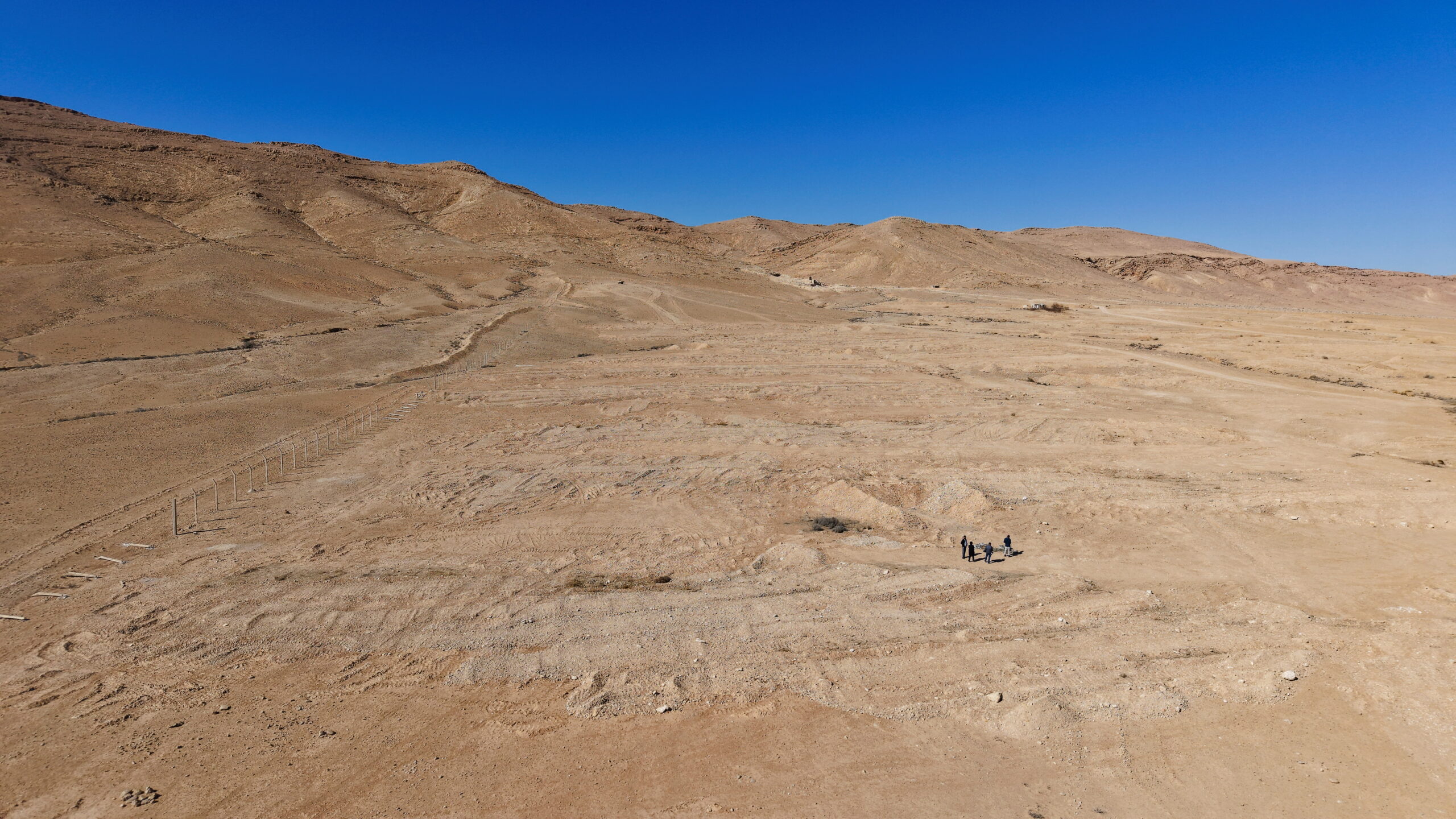
The time lapse of satellite imagery was completed, providing high-resolution images and digital data across many areas at both sites, including surface soil and deeper soil horizons. The RGB jpgs and drone imagery obtained by Reuters was invaluable for discussing where the activities had likely taken place. Discussion between Professor Dawson and the Reuters team soon turned to further close capture of the soil appearance through the use of drone imagery.
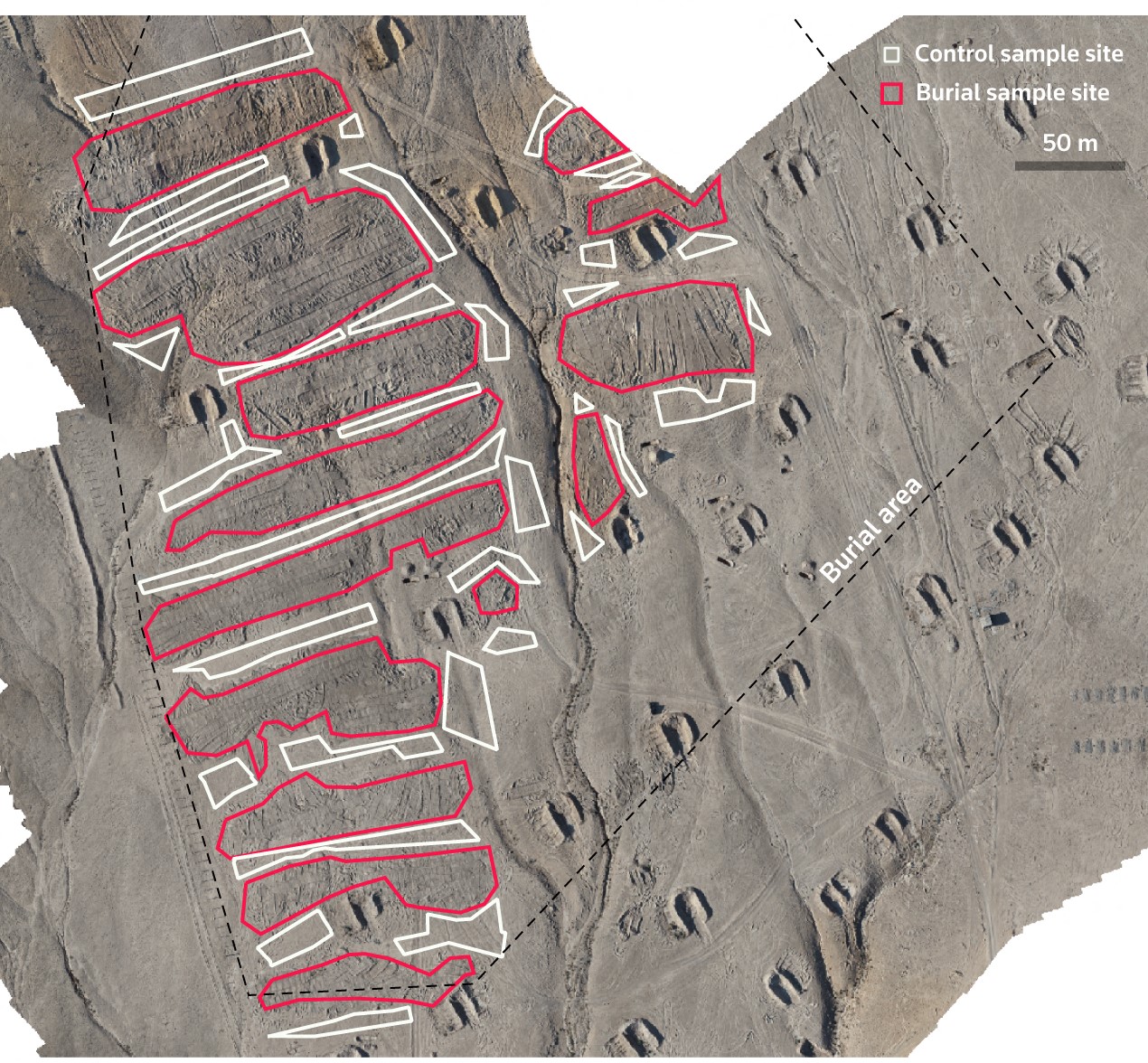
The composite image generated by the drone flight revealed a detailed look at the covered burial trenches. A comparison between the disturbed earth and the control sites, where there was no digging, found a distinct colour shift, helping corroborate witness accounts of how bodies were transferred from one mass grave to another.
Source: Benjamin Rocke, Lorna Dawson, Reuters reporting
Travis Hartman/REUTERS
Professor Dawson suggested to Reuters that they also bring in her colleague, Dr Alastair Ruffell from Queens University, Belfast, as an expert in remote methods of detecting anomalies, and his newly graduated PhD researcher, Dr Ben Rocke, as an expert in drone technology. All three scientists are members of the International Union of Geological Sciences, Initiative on Forensic Geology (IUGS IFG), where international colleagues work together to develop cutting edge science and apply principles of forensic geology and soil science in criminal and civil investigations across the world.
Together, with on the ground Reuters staff, the team created a flight path and captured multispectral data at high resolution. Reuters used comparative soil techniques to further corroborate their main finding: that Bashar al-Assad’s government transferred thousands of bodies from one mass grave in the Damascus suburb of Qutayfah to a hidden location in Syria’s Dhumair desert. The analysis drew on thousands of drone photographs that were stitched together to create two high-resolution composite images.
Reuters said: “The transfer of bodies and the existence of the new mass grave in the Dhumair desert were revealed for the first time by Reuters last week. How many are buried there remains unknown. Soil samples taken from the two grave sites would provide scientific confirmation of the transfer of bodies from Qutayfah to Dhumair. Exhumation would reveal the number of bodies transferred.”
When any destructive sampling and analysis is carried out at the Dhumair site, it will need to be following strict forensic protocols and the highest possible quality standards.
As Dhumair’s burial trenches were filled, satellite imagery captured at the time appeared to show colour changes in the soils around each grave. However, atmospheric conditions can affect how satellites capture colour, and images from even the most sophisticated commercial providers lack the resolution needed for a close examination of the soil.
To corroborate the witness accounts and satellite imagery analysis, a question arose: was there a way to use science to further establish the link between the two mass graves without tampering with a site that could, in the future, be treated as a crime scene?
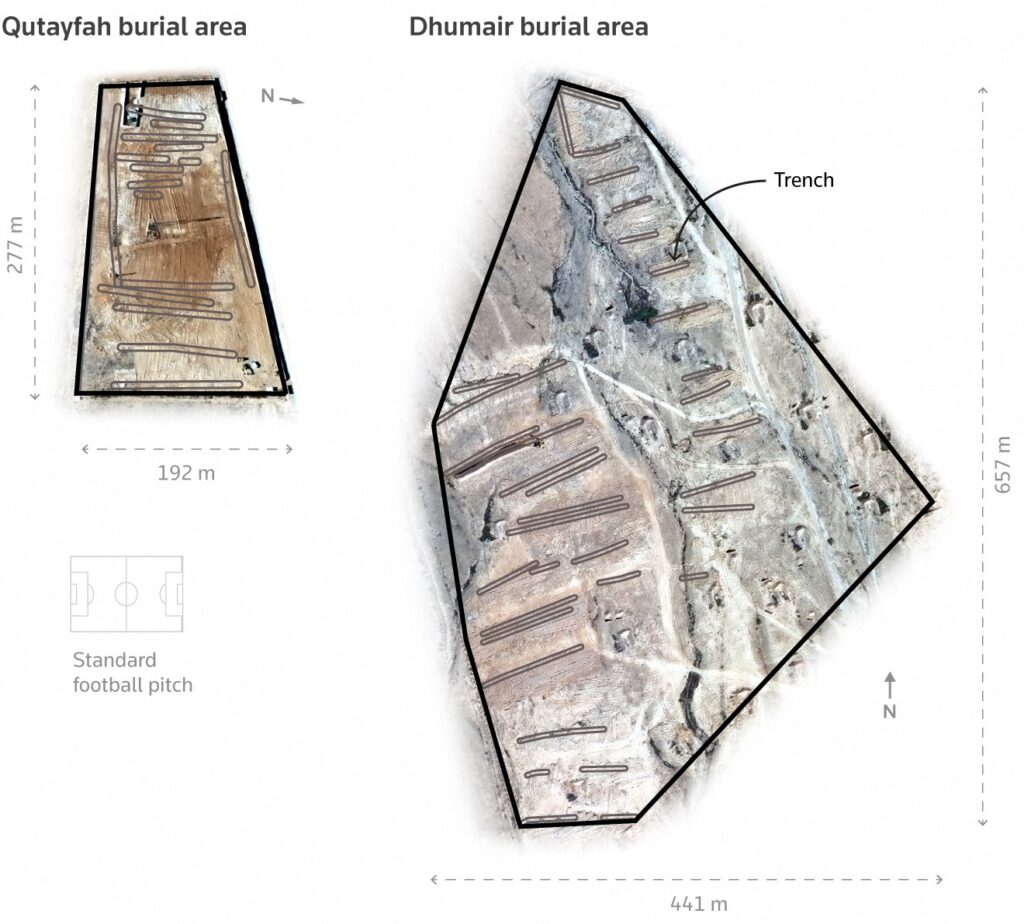
At Qutayfah, Reuters found 16 burial trenches ranging in length from roughly 15 metres to 160 metres. At Dhumair, there were at least 34 trenches ranging in length from about 20 metres to 125 metres.
Source: Satellite images from WorldView-2 imagery © 2025 Vantor. December 18, 2021; WorldView-3 imagery © 2025 Vantor. March 8, 2021. Reuters analysis; Airbus DS, Vantor and Planet Labs.
Ryan McNeill and Travis Hartman/REUTERS
A total of over 2,000 images were collected at both sites and combined to create a detailed composite of the original mass grave at Qutayfah. The site contained three pits that the geologists in the team used as visual references to compare the subsoil colour with Dhumair. The pits first appeared in satellite images taken by Reuters this year, after Assad’s fall from power.
The high-resolution drone images revealed bulldozer treadmarks, differing elevations, and patches of soil detailed enough for a direct comparison between the soil colours at Qutayfah and Dhumair. The drone took thousands of overlapping photos, allowing photogrammetry software to link them together into composite images 10 times sharper than the previous satellite images.
Together, the researchers used drone imagery to create soil colours from both grave sites using the Munsell system, a standardized classification that organises colours by hue, which shows basic colour; chroma, which shows the colour intensity; and value, which reveals lightness or darkness. This system is used in the description of soil samples in criminal investigations often as a first step in the process and can also provide quantitative values which can then be statistically compared.
Professor Dawson and Dr Rocke found that the colour of the subsoil in the holes recently dug at the Qutayfah site had a Munsell colour of 10R 5/2 (weak red), on the reddish end of the spectrum. Meanwhile, they also calculated the Munsell colours at the new site at Dhumair (10YR 6/1 (gray) allowing a direct comparison between the two locations.
At Qutayfah, the site of the original mass grave, the drone captured detail from empty pits in the earth dug at some point since Assad’s fall – both within the mass grave area and nearby. The imagery revealed red and yellow subsoils that likely could have been excavated along with human remains. At Dhumair, the drone flights showed the disturbed soil was redder and darker than nearby undisturbed areas – the kind of change that would be expected if Qutayfah’s subsoil had been added to the greyer coloured soil seen naturally at Dhumair.
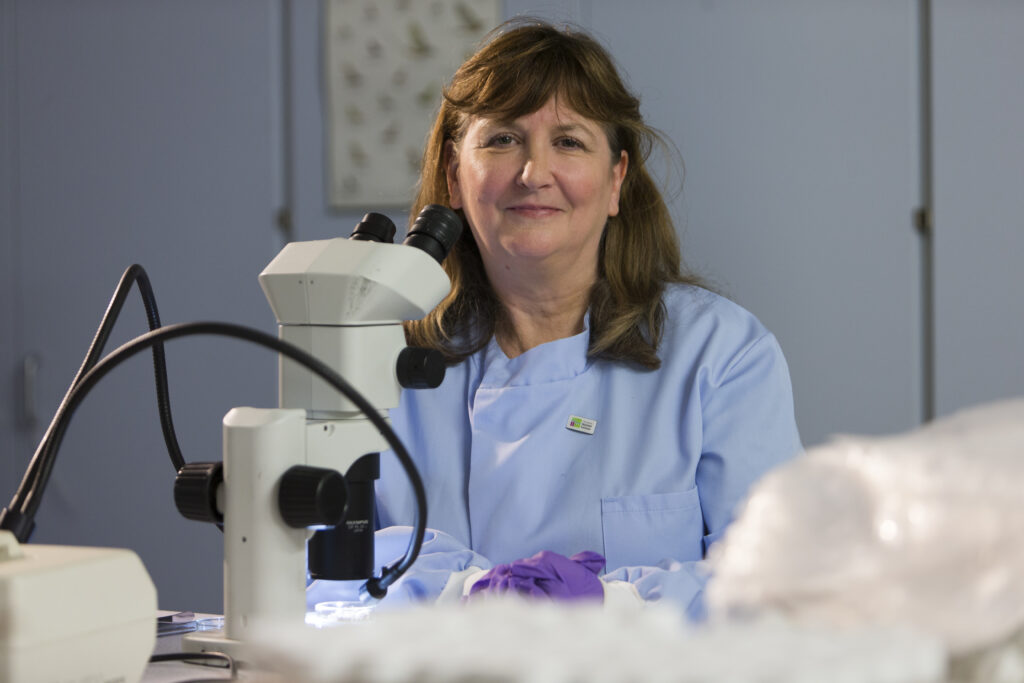
Credit: Ross Johnston/Newsline Media
The analysis of the drone imagery supports the findings of the Reuters team investigation, where reporters first discovered the site of the mass grave in the Dhumair desert after speaking with more than a dozen witnesses directly involved in its creation. The witnesses included drivers, soldiers, mechanics and diggers, who recalled the journeys between the original mass grave near Qutayfah and the newly identified Dhumair site.
The Reuters reporting team also reviewed documents created by Syrian officers involved in the ‘Operation Move Earth’ to transfer the bodies. Reuters also analysed more than 500 satellite images that were key to determining the size of the mass burial site at Dhumair and the synchrony between graves being emptied at Qutayfah and the new ones were created at Dhumair. This activity took place from February 2019 to 2021.
On October 17, Reuters published a video explaining their findings and a long-form article going into further depth on how the discovery was made.
Professor Dawson said, “It’s heart-warming that some good has already come from this investigation: the Syrian government has ordered the Interior Ministry to send guards to seal and protect the site.
“Later will start the painful process of recovery and repatriation of loved ones. Secrets lie in the soil, and hopefully, if carried out in an appropriate and regulated forensic manner, the truth will prevail, and families will find out what happened in the past and eventually be able to bury their loved ones.”
Blog by Media Officer, Matteo Bell, matteo.bell@hutton.ac.uk, and Professor Lorna Dawson.
Disclaimer: The views expressed in this blog post are the views of the author, and not an official position of the Hutton or funder.
