Legume companions for barley – a panacea for improving soil health and reducing fertiliser use
While most in the farming industry accept the potential benefits of companion cover cropping for soil and crop improvement, I am working on a project exploring how these benefits support environmental sustainability.
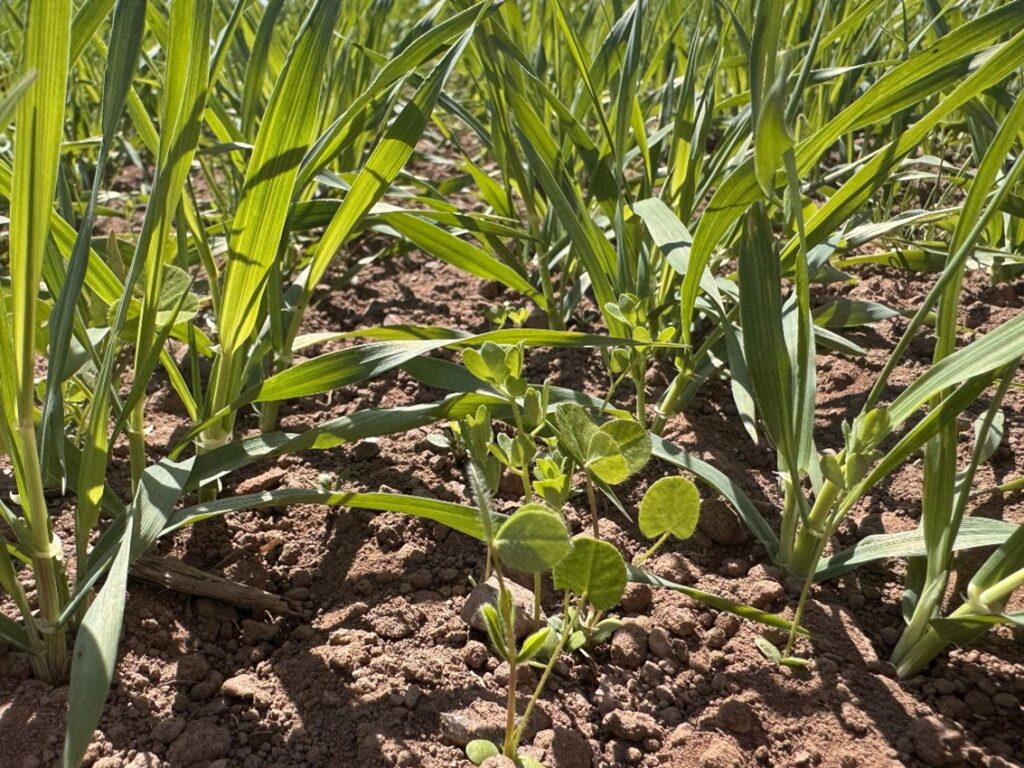
Close-up of barley–legume companion cropping system at Pilmore Fields, Dundee, showcasing intercropped legumes for soil health and resilience.
Our study aims to inform farmers who might want to adopt more sustainable practices, by measuring the yields achieved under the different fertiliser application rates and quantifiable improvements in soil health.
We are investigating how companion cover cropping with legumes influences soil structure structure, nitrogen levels, and overall nutrient concentration in comparison to barley-only plots and assessing both positive and potentially negative impacts on spring barley yield and quality through field trials. We’ll also look at how cereal crops, specifically spring barley, would fare when grown together with herbaceous legumes in a companion cover cropping system, and what changes this could bring for soil health.
One of the key objectives of this project is to understand nutrient dynamics and how we can enhance the organic nitrogen content in soil through herbaceous legumes, nitrogen that can then be utilised by barley plants.
In traditional intercropping or cover cropping systems, some legumes (pea, beans, and grass pea) can compete with the main crop for nutrients, water, and light, which can reduce yields. However, in this study we are growing primarily different clover and bird’s foot trefoil varieties alongside two spring barley varieties, as these legumes not only fix atmospheric nitrogen with the help of soil microbes, and improve soil structure, but also act as ground cover, or mulch, reducing competition for nutrients and protecting the soil surface against, for example, erosion. They should create conditions that support better barley growth.
Clover and bird’s-foot trefoil are common herbaceous legumes that grow naturally across Scotland. Through biological nitrogen fixation –
- White clover can fix about 150-220 kg of nitrogen per hectare per year*
- red clover, 150-350 kg*, and
- bird’s foot trefoil averages 50-145 kg*
In contrast, barley typically receives 90-150 kg of nitrogen per hectare* as synthetic fertiliser but only takes up 50–70% of this. The remainder is lost, with 10–30% leaching into groundwater.
When legumes fix nitrogen, their residues release it gradually. 30–50% of this nitrogen remains available for subsequent barley crops, reducing fertilizer needs and improving soil health through soil biological communities decomposing the residues. Integrating clovers and trefoil into rotations thus enhances sustainability and potentially reduces cost but maintains barley yield.
What are the challenges?
While regenerative agriculture aims to restore soil health through practices like cover crops and pasture resting, it is not always straightforward. Challenges include
- the short window for establishing cover crops
- their removal before sowing
- reliance on herbicides, which pose environmental and health concerns
- mixed farming also limits grain production and conflicts with climate goals
Continuous living mulches using herbaceous legumes offer a promising solution to these issues.
*More information from the Agriculture and Horticulture Development Board on red and white clover is available here and on bird’s foot trefoil here
Information on nitrogen supply, demand and utilisation is available here
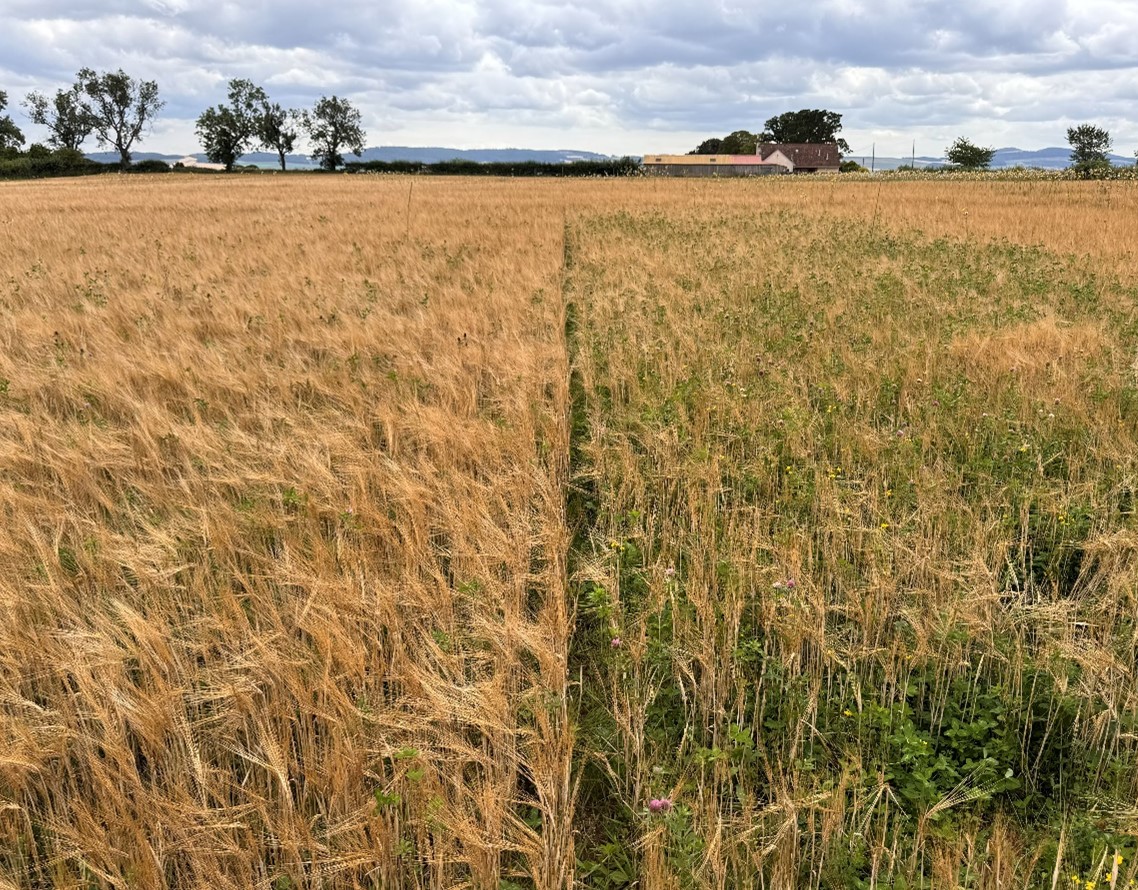
Blog by Qurat Ul Ain Ali Hira, PhD researcher at The James Hutton Institute, working under the supervision of Dr. David Boldrin, in collaboration with the University of Dundee, and The Maltsters’ Association of Great Britain as part of the BARIToNE PhD training programme
Disclaimer: The views expressed in this blog post are the views of the author, and not an official position of the Hutton or funder.
