Scotland–UAE Agrifood Engagement: From Continuity to Capability-Led Collaboration
Last month, colleagues from The James Hutton Institute and its Scientific Services team joined a delegation that included the Deputy First Minister of Scotland, and representatives from industry, on a visit to the United Arab Emirates to build on the momentum established during Global Food Week in Abu Dhabi in October.
That previous visit saw the first structured Scotland-UAE dialogue on climate-resilient crops, controlled environments, proteins and enabling data systems between the Hutton and the Abu Dhabi Agriculture and Food Safety Authority (ADAFSA) so this was the time for the next step: moving from shared intent to practical collaboration pathways.
Our delegation included representatives from Hutton flagships:, the Advanced PlantGrowth Centre (APGC), the International Barley Hub (IBH), and the NationalAlternativeProtein Innovation Centre (NAPIC). This allowed discussions to span plant science, breeding, controlled-environment systems, data and AI, and food-system innovation – reflecting how agrifood challenges are tackled in practice rather than in silos.
Monday – Dubai: markets, scale, and policy signals
The visit began with our participation in a major international exhibition at the World Trade Centre, Dubai, providing exposure to the global agrifood market, technology providers and investors operating at scale.
Alongside this, we met with the Ministry of Climate Change andEnvironment, which highlighted clear interest in:
- Data handling, AI
,and visualisation to support decision-making across agrifood systems, especially regarding country-wide weather data and data from farms - Medicinal and functional plants, including controlled production and quality assurance
- Certification frameworks for controlled-environment agriculture (CEA), covering both production systems and produce emerging from them
These conversations reinforced the UAE’s focus on evidence-based regulation and the need to connect biological performance, digital infrastructure, and standards if CEA systems are to scale credibly.
Tuesday – Dubai: Expo City and FoodTech Valley
We attended a large-scale exhibition at Expo City Dubai, with discussions centred on FoodTech Valley and companies planning to locate there. Engagement focused on ReFARM’s integrated model linking regenerative agriculture, vertical farming, and environmental conservation, and on the role of controlled-environment agriculture in enabling resilient food production, seedling supply, and land restoration while reducing pressure on fragile ecosystems. The discussion highlighted how applied research, phenotyping, data, and systems-level design are critical to scaling these approaches, with Intelligent Growth Solutions referenced as a relevant technology provider.

Later that evening, a Scottish Week reception provided an informal setting for further engagement across the food and drink sector, alongside a strong showcase of Scottish produce, reinforcing the depth of the sector and its international appeal.
Wednesday – Abu Dhabi: embassy roundtable and ecosystem alignment
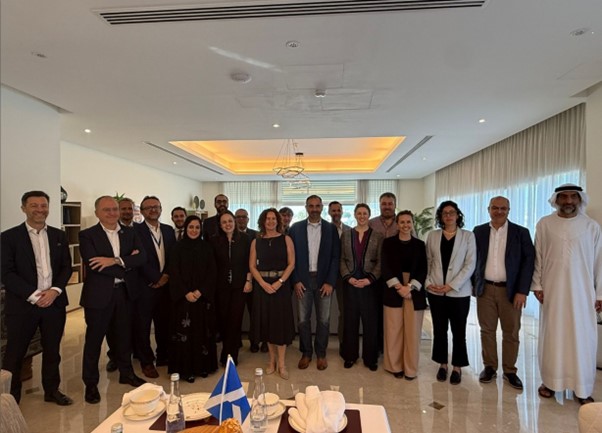
Kate Forbes, Deputy First Minister of Scotland, hosted a high-level roundtable at the British Ambassador’s Residence in Abu Dhabi under the Gulf Strategy Fund (GSF) framework, as part of the Scottish Week programme.
The session brought together senior stakeholders from the Scottish Government and Scottish Development International with key UAE and international partners spanning regulation, food security, investment, research, and advanced agrifood technologies. UAE participation included leadership from the Abu Dhabi Agriculture and Food Safety Authority, the Abu Dhabi Investment Office, SILAL Innovation Oasis, Elite Agro-Wusoom, the Quality and Conformity Council, ReFARM Global, Khalifa University Enterprises, and the International Center for Biosaline Agriculture.
Scottish research and industry were represented by our Hutton delegation alongside Scottish agritech and life sciences companies including Roslin Technologies, MI:RNA, and I Livestock, contributing expertise across crop and livestock innovation, molecular and microbial systems, data-driven decision support, and commercial-scale deployment. This mix enabled a genuinely end-to-end discussion across regulation, public investment, production systems, applied research, data infrastructure, and enabling technologies.
A clear and consistent message emerged around the importance of portfolio-based, co-funded programmes that link applied R&D, piloting, and scale-up, rather than isolated or transactional projects. The roundtable laid the groundwork for structured follow-up through joint working groups and deeper technical collaboration between Scottish and UAE partners, reinforcing a shared ambition to translate innovation capability into delivery at scale, particularly in support of food security and resilient local production.
Thursday – Al Ain: focus on innovation delivery at SILAL
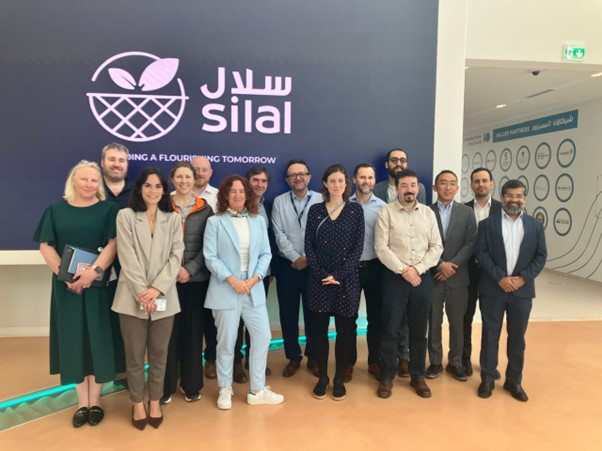
A visit to SILAL’s Innovation Oasis, hosted by CEO, Dr Shamal Mohammed, highlighted the Innovation Oasis as a serious platform for applied R&D, piloting, and scale-up across the UAE Agri-Food system, using cutting-edge technologies.
We explored how SILAL’s facilities and ambition align with Scottish strengths in phenotyping, controlled-environment agriculture, crop improvement (stress resilience and nutrient quality), and data-enabled decision support. The visit reinforced the scale of opportunity for collaboration when innovation infrastructure is explicitly designed to bridge research and deployment.
What comes next – structure before scale
A key outcome of the week was agreement on how to take this forward.
- Establish joint working groups, led by the Hutton and ADAFSA, around the priority themes identified
- Take discussions into greater technical depth, including data, infrastructure, crop systems, and standards
- Explore co-funding approaches that enable programmes and portfolios—rather than isolated projects—to be developed and delivered jointly
This approach reflects a shared understanding that long-term impact comes from structured, co-designed programmes with clear governance and shared ownership.
Looking ahead
Our visit marks a clear continuation of a growing Scotland–UAE partnership and demonstrates how capabilities anchored at the Hutton’s APGC, alongside IBH and NAPIC, can support collaboration well beyond Scotland and the UK. As an internationalisation tool, this capability is most powerful when applied through trusted partnerships, shared priorities, and delivery-focused programmes.
Follow-up work with UAE partners is now underway, and The James Hutton Institute looks forward to progressing the next phase of collaboration in the months ahead.
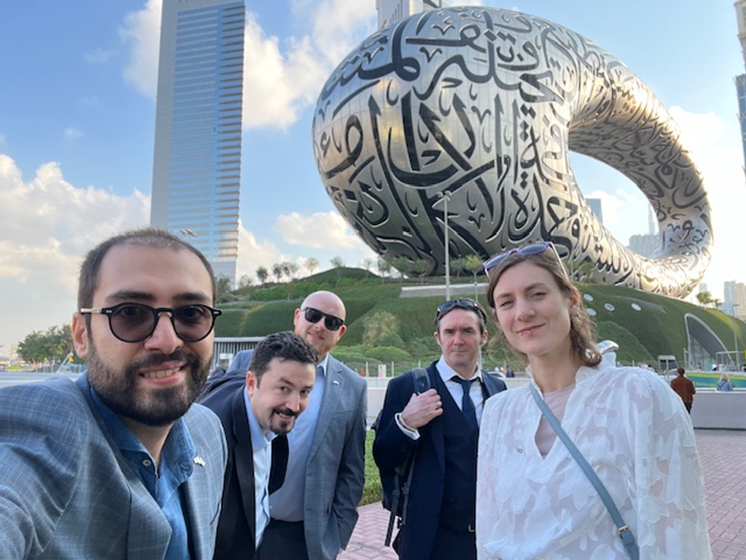
The Hutton delegation comprised
- Dr. Rob Hancock – Deputy Director, Advanced Plant Growth Centre
- Ramin Ebrahimnejad – Business Development Manager, Advanced Plant Growth Centre
- Dr. Gwendolyn Kirschner – Root Ecophysiologist
- Dr. Raul Huertas – Plant Molecular Physiologist; Co-Head, Plant Adaptations, Biochemistry & Food Quality
- Fraser Macfarlane – Machine Learning Research Scientist
This engagement was made possible through strong coordination and support, and we thank:
- The Gulf Strategy Fund (GSF) under the Foreign, Commonwealth &Development Office
- Scottish Development International for in-country support and relationship building
- The Scottish Government, and Kate Forbes, for her sustained dedication to building long-lasting international partnerships in agrifood and innovation
If you’d like to know more about this programme and the associated working groups, please reach out to Ramin Ebrahimnejad, Ramin.Ebrahimnejad@huttonltd.com
Blog by Ramin Ebrahimnejad, Business Development Manager, Advanced Plant Growth Centre, JHL
Disclaimer: The views expressed in this blog post are the views of the author, and not an official position of the Hutton or funder.