Centre for Sustainable Cropping (CSC)
A unique open research facility driving evidence-based sustainable arable systems
Established in 2009, the Centre for Sustainable Cropping (CSC) is the UK’s first long-term whole-system research platform dedicated to regenerative agriculture. It evaluates how sustainable management practices influence soil health, biodiversity, pollution and crop productivity over decades.
The CSC
The CSC long-term experiment aims to achieve multiple economic, environmental and ecological benefits from arable land. The platform has been running since 2009 as a field-scale comparison of regenerative cropping against standard agronomic practice over multiple arable rotations. The regenerative system integrates reduced tillage, organic matter amendments, mixed legume-based cover and companion cropping, threshold pest and disease monitoring, targeted crop protection, biofortification and nutrient budgeting to reduce reliance on chemical interventions by promoting soil health, plant fitness and biodiversity (Hawes et al. 2021). This system is compared with a conventional ploughed system that follows standard commercial practices of blanket fertilizer applications and prescriptive, prophylactic pest and disease treatments.
Replication is year-on-year, but large field sizes allow commercially realistic estimates of costs and benefits (Roberts et al. 2019). Trends in soil properties, biodiversity, crop yield and financial margins are used to review how well the sustainability objectives are met and guide further improvements in system design (Hawes et al. 2019).
The CSC’s developing production system addresses three major global challenges facing agriculture to date:
The Food Security and Human Health, The Climate Emergency and The Biodiversity Crisis.
Cathy Hawes, Research Scientist
Our whole-systems approach combines best practice options for multiple long-term benefits. Impacts on long-term trends in key systems indicators at commercially realistic field scales are used to guide further improvements in crop system design, resulting in better soil health and enhanced biodiversity while maintaining crop yields
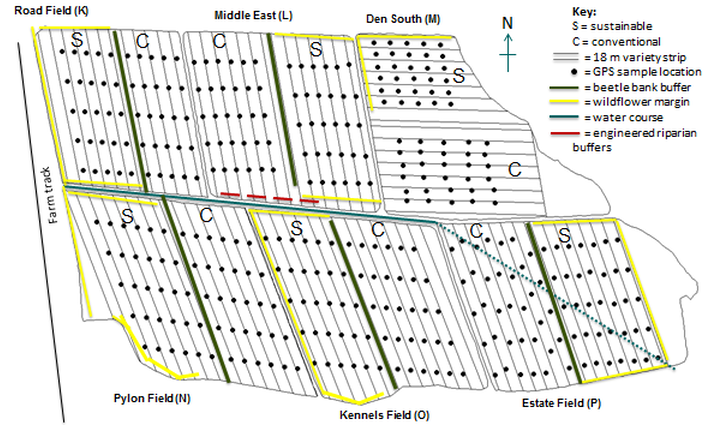
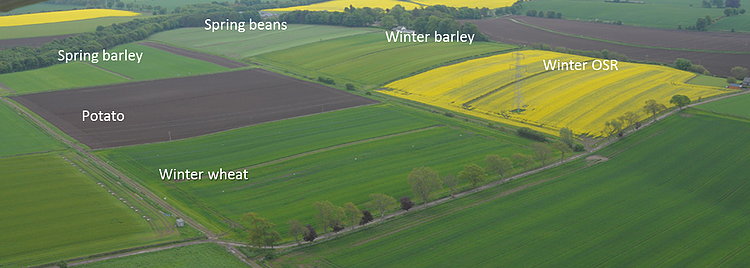
CSC’s approach to addressing food security and human health focuses on adopting more resource-efficient production systems, diverse crop types, and improved varieties to maintain yields and enhance product quality. In response to the climate emergency, the CSC aims to enhance soil biophysical quality while reducing reliance on mineral fertilizers, thereby minimizing pollution and losses due to runoff, leaching, erosion, and greenhouse gas emissions. To tackle the biodiversity crisis, the CSC is committed to conserving arable habitats, diversifying field margins, and fostering beneficial in-field weed communities. By implementing integrated pest management strategies to lessen dependence on crop protection chemicals, the CSC seeks to enhance biodiversity, improve system resilience, and promote the delivery of essential ecosystem services. For more information visit: Centre for Sustainable Cropping.
Hawes, C., Iannetta, P.P.M., Squire, G.R. (2021). Agroecological practices for whole system sustainability. CAB Reviews, 16, no. 005.
https://doi.org/10.1079/PAVSNNR202116005
The Centre for Sustainable Cropping is a long-term field experiment that studies how sustainable farming practices can improve soil health, crop productivity and environmental outcomes. Through research collaborations, James Hutton Institute Scientific Services supports work that evaluates integrated crop management strategies in real agricultural systems.
Long-term experiments allow scientists to understand how farming practices affect soil health, biodiversity and crop productivity over time. The Centre for Sustainable Cropping provides valuable insights that help guide more sustainable agricultural practices.
Research at the CSC investigates crop rotations, reduced pesticide use, soil management and biodiversity-friendly farming approaches. These studies help identify strategies that balance productivity with environmental sustainability.
contact for more information
Cathy Hawes
Research Scientist
Based in Dundee
T: +44 (0)344 928 5428 (*)
I am an ecologist working on arable biodiversity and agroecosystem sustainability in the Ecological Sciences Department at The James Hutton Institute since 2011, and previously at the Scottish Crop Research Institute (SCRI) Environment-Plant Interactions Programme (2005-2011). Prior to this, I was the Associate Programme Leader for SCRI’s Environmental Management and Biotechnology program (2002-2005) and Co-ordinator on the Defra funded Farm-Scale Evaluations of GMHT crops (1999-2003, Hawes et al. 2003). My PhD on forest structure and the community ecology of predatory insects was conducted at Forest Research and the University of Sussex (1996-1999) as part of the Forestry Commission’s Biodiversity Research Programme (Hawes et al 2002, 2013).
