Growing beans before barley could cut farming’s environmental footprint
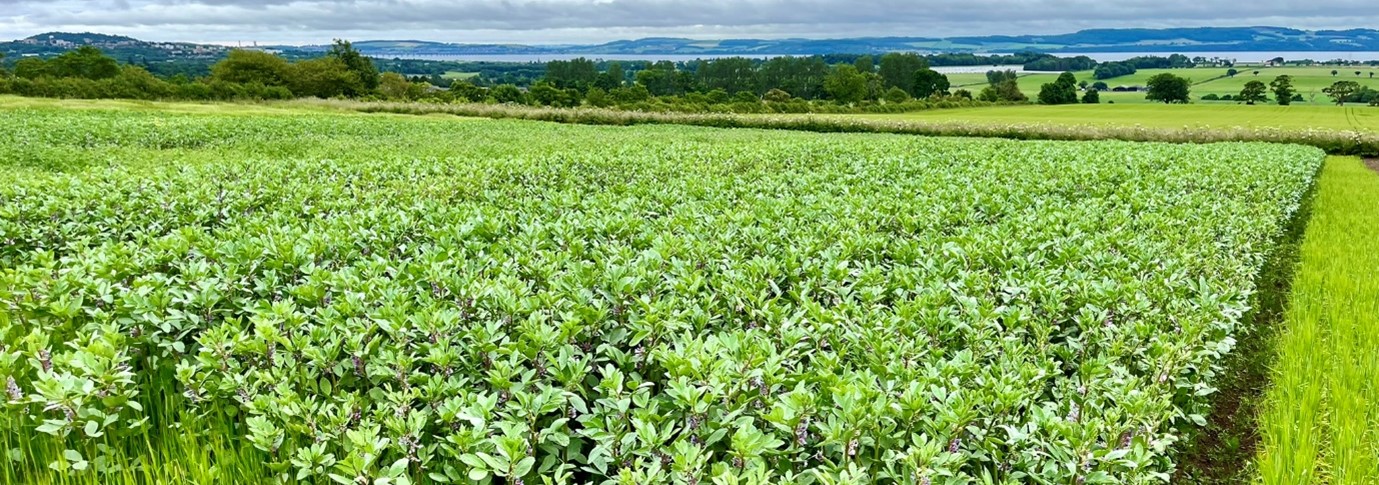
Long-term research from The James Hutton Institute, working with the University of Galway, has shown that putting field beans into cereal rotations can reduce fertiliser use, lower environmental impacts and, in most years studied, increase the yield of the barley crop that follows.
Scientists analysed data from the Hutton’s long-running research at its Centre for Sustainable Cropping (CSC) at Balruddery Farm near Dundee for the study, published in Plant and Soil, which compared spring barley grown after field beans with barley grown after barley.
Dr Cathy Hawes, who leads research at the CSC, said, “The CSC was established to test what genuinely regenerative cropping can look like in practice.
“This is an important study because there are still relatively few life-cycle assessments that look properly at crop sequences. Regenerative agriculture is fundamentally about system function across time.”
Professor Pietro Iannetta, The James Hutton Institute
“Rather than relying on a single intervention, CSC stacks a series of complementary innovations including reduced tillage, organic matter inputs, cover and companion cropping, more targeted pesticide use, nutrient budgeting and biodiversity-supporting field features with the aim of maintaining productive farming while reducing reliance on external inputs and improving soil condition, biodiversity and wider environmental performance over the long term.
“These results show that the benefits of that approach can carry from one crop into the next, rather than being confined to a single growing season.”
A major reason for the finding is biologically derived nitrogen. Field beans are legumes and work with naturally occurring soil bacteria to obtain nitrogen from the atmosphere. This means they need no synthetic nitrogen fertiliser – one of the dominant contributors to the environmental footprint of crop production – and can leave a useful nitrogen legacy for the crop that follows.
In this study, synthetic nitrogen fertiliser use for barley following beans was reduced by, on average, 22 kg per hectare. Pesticide use, another major contributor to the environmental footprint of crops, can also be substantially lower after field beans.
Across five two-year cropping periods, growing field beans before spring barley reduced the environmental impact of barley production in four of the five periods. Averaged across the crop sequences, environmental impacts were reduced by around 25%.
There was also a potential productivity benefit. Across the five years examined, spring barley following beans yielded an average 1.2 tonnes per hectare more than barley following barley in four of the five years.
However, the researchers caution that beans are not an automatic guarantee of higher yields. In the unusually dry conditions associated with the 2022 barley crop, barley following beans yielded less than barley following barley. The study suggests that weather, particularly temperature and humidity, together with how well the preceding bean crop performed, strongly influences the benefit received by the following cereal.
Professor Pietro Iannetta, co-author of the study, said, “This is an important study because there are still relatively few life-cycle assessments that look properly at crop sequences. That matters because regenerative agriculture is fundamentally about system function across time.
“The next challenge is to go beyond measuring impact reduction alone and ask whether those reductions are matched by real gains in ecosystem functions, including soil processes, nutrient cycling and biodiversity.”
“Further advanced life cycle analysis (LCA) work is now underway at the CSC to link reductions in environmental burdens with measured changes in ecosystem functioning. That should help us move from saying a system uses fewer inputs, to demonstrating whether it is genuinely delivering regenerative outcomes.”
The findings are particularly relevant to Scotland, where spring barley underpins major brewing, distilling and livestock industries. A theoretical scaling exercise in the paper estimated that wider adoption of bean–barley sequences could offer substantial greenhouse-gas reductions, although the authors stress that this national estimate requires further testing across different soils, farms, and seasons.