Gordon McDougall

Senior Research Scientist, Head of Plant Biochemistry and Food Quality Group
Environmental and Biochemical Sciences
T: +44 (0)344 928 5428 (*)
I am the leader of the Plant Biochemistry and Food Quality Group. I have applied various analytical techniques, including metabolomics, to examine how agronomy, new production methods (such as vertical farming), climate change, genotype, or processing influences plant biochemistry and product quality. I have worked on many phytochemicals (especially polyphenols) but with a focus on how they influence  human health, oftren using LC-MSn methods.  My >150 peer-reviewed papers (H-index 51, > 7800 citations) include collaborations on phytochemicals that modulate cancer, neurodegenerative and cardiovascular models but also influence obesity and diabetes.  The group also works on components that influence nutrition, flavour, colour, sensory experience and texture. Increasingly in the future, I see these analytical skills being applied to assess the recovery of value-added components from food waste/co-product streams to improve circular economy approaches for food and plant product delivery.

From 2016-present I have been a Grade G, Senior Principal Investigator at the James Hutton Institute and have been Leader of Plant Biochemistry and Food Quality Group since 2014. I increasingly work alongside James Hutton Limited (e.g.) on their work on cannabinoid analysis and other natural products, interacting with many companies in the food and crop product areas and have also developed expertise in seaweed analysis.
I have been in charge of deliverables for the Scottish Government Research Programme since 2014 and am a Honorary Lecturer at University of Dundee.

I began work at the Scottish Crop Research Institute in 1989 having previously worked as a post-doc under Prof. Steven Fry at  Department of Botany, University of Edinburgh. I completed my PhD under the supervision of Prof. Graham Gooday in Microbial Biochemistry, University of Aberdeen in 1986 and was awarded BSc (Hons) 2:1 Biochemistry from the University of Glasgow in 1982.

The main focus of research in PBFQ is to understand the chemical, biochemical and genetic basis of quality of foods and crop products. Quality is defined as any valued aspect of the crop and ranges across many areas from the composition and levels of

  • macronutrients such as starches, fats, proteins, and dietary fibres
  • micronutrients such as minerals, carotenoids and vitamins
  • anti-nutrient components such as phytates, tannins, glycoalkaloids and by-products (e.g., acrylamide)
  • health beneficial components such as polyphenols, triterpenoids, and polysaccharides
  • to phytochemicals that find use as pharmaceuticals, chemical precursors, colours, or flavours
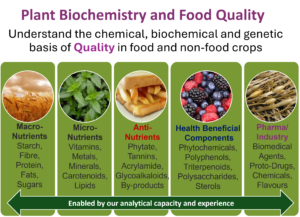
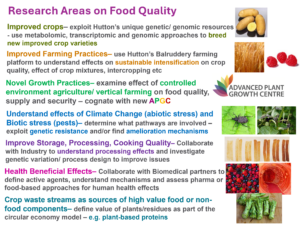
PBFQ applies its analytical capabilities and experience to examine the levels of these various components. Obviously different foods have different key components such as starches in potatoes and cereals, proteins in pulses and polyphenols in berries. Research focuses on the effect of various factors that can influence food and product quality including the effects of genetics such as the introduction of new varieties that have been selected for improved flavour, resistance to pests, ability to yield under reduced nutrient availability or the greater abiotic stresses predicted under climate change scenarios.

We also look at the effects of changing growing techniques such as the Balruddery system (https://csc.hutton.ac.uk/) to reduce inputs to achieve sustainable intensification of food production to the new vertical farming systems that can completely control all parameters of plant growth. These areas fit well with the Hutton flagship initiative of the Advanced Plant Growth Centre (https://apgc.org.uk/) which examines the mechanisms and genetics of improving plant quality. We are also interested in understanding how plants adapt to biotic stresses such as pests and diseases and how this can influence food quality.

We also collaborate with industry partners to improve post-harvest treatments of crops such as storage, processing, cooking methods and formulation to improve final product quality. We often investigate genetic variation or examine process design to improve these issues.

There is increasing evidence that non-nutrient components of fruit and vegetables (FAV) may have key roles in providing the health benefits associated with FAV-rich diets. A major thrust of my research examines the possibility that phytochemicals in plant foods can provide human health benefits. A key area has been on polyphenols in berries, and we have been involved in collaborations with biomedical teams to

  • Establish bioactivities relevant to human health for berry polyphenols
  • Analyse the composition of polyphenols in bioactive extracts to confirm structure-activity relationships for effectiveness and to assess the stability and bioavailability of active components in the human body
  • Develop high through-put methods to analyse the inheritance of bioactive polyphenols in berries, to link the ‘health’ phenotype to the genotype of Hutton’s elite germplasm collection. This led to establishment of QTLs for specific HBCs in raspberry and blackcurrant (https://doi.org/10.1007/s11306-023-02033-7) that can be used as genetic markers for accelerated breeding of varieties with tailored composition.
  • Assess environmental influences on the accumulation of levels of bioactive components (https://doi.org/10.1016/j.foodchem.2022.134360)

Similar approaches have been taken with other potential health beneficial components including carotenoids in microalgae (https://doi.org/10.3390/biology7010002) and sesquiterpene lactones in lettuce (https://doi.org/10.3390/nu12113547).

We are also applying our analytical expertise and experience to assess crop waste streams as sources of high value food or non-food components, this circular economy approach has been used to obtain high quality plant-based proteins from agricultural waste streams (https://apgc.org.uk/800k-government-grant-for-broccoli-protein-upcycling-consortium/). PBFQ is active in the Produce Pillar of the new National Alternative Protein Innovation Centre (NAPIC – PEOPLE – NAPIC) We are also examining co-products from various food crops as sources of reformulation agents that can help reduce the levels of fats, sugars, and salts in processed foods through a “health-through-stealth” approach.  We have extended this biorefinery – no waste approach to examining the valorisation of seaweed co-products (https://doi.org/10.1007/s10811-022-02895-9). We have considerable experience in analysing for the high value components of seaweeds and running trials to confirm biostimulant effects on crop plants.

Past research

Through collaborations with biomedical groups with relevant model systems for cardiovascular health, neurodegeneration, diabetes, and cancers, we examined extracts with closely defined compositions for bioactivities. The studies include analysis of the metabolic fate of the components to define the mechanisms of action and the candidate active ingredients (https://doi.org/10.1016/j.redox.2021.101862). In human trials, bioavailability studies of the levels of metabolites in blood, urine and faeces were examined.

Through these studies, I have confirmed that different polyphenol components from berries can have different effects in different model systems and that overall efficacy is often decided by a combination of bioactivity, stability, and longevity/bioavailability in the system. These cross-disciplinary collaborations have led to close associations particularly with the University of Ulster and Universiade Nova de Lisboa, and funded through various EU grants (e.g., BrainHealthFood).

Along with Will Allwood, I have established novel MS based methods for following polyphenol diversity. This has enabled us to link polyphenol inheritance to the genetic maps being developed for raspberry and blackcurrant by CMS and BioSS colleagues (Julie Graham & Colin Alexander). Through this approach, we established QTLs which may enable accelerated breeding of improved varieties with elevated levels of healthy components. The high-through-put methods developed have been employed to track the diversity of polyphenols from growing berries under different agronomic conditions, in different latitudes or after different processing methods with collaborators from across Europe (e.g., https://results.northsearegion.eu/en/projects/Future-proofing-the-North-Sea-berry-fruit-industry-in-times-of-climate-change.122/).

I have also been involved in studies that correlate the metabolic and molecular changes associated with aspects of food quality. For example, through close working with CMS colleagues, we correlated changes in metabolite profiles and gene expression in coloured and non-coloured potato tuber tissues controlled by different microRNAs (https://doi.org/10.3389/fpls.2018.01742).

I have also applied expertise in cell wall chemistry and biochemistry to studies on sweet potato texture related to cooking time and consumer preferences in Sub-Saharan Africa. This Bill and Melinda Gates Foundation project (https://rtbfoods.cirad.fr/) established links between varieties and textural properties which may lead to faster cooking varieties but with texturally acceptable characteristics which may extend the range of practically used genotypes and improve diet and health. This built on work on the genetic and biochemical basis of potato tuber texture by comparing differences in textural properties between Solanum tuberosum and Solanum phureja varieties.

With industrial and university partners, and often working through our commercial arm James Hutton Ltd, I have been very active in applying our analytical capacities to solve problems associated with product flavour, manufacture and the effects of processing and cooking on bioactive components from diverse sources, such as seaweeds and oats.

We have built collaborations with British Universities including Glasgow, Ulster, Dundee, Reading, Abertay, Queen Margaret, Newcastle, Sheffield Hallam, Strathclyde, Aberystwyth, University of the Highlands and Islands and St Andrews. International collaborations are in place with scientists from Universities and Research Institutes in, e.g., Germany, Italy, Bulgaria, Spain, Norway, Sweden, Denmark, France, Holland, Ireland, Portugal, USA and New Zealand. We also have a network of research partners in UK and European companies but are open for discussions in any new ventures.


The following Publications have not yet been migrated to the James Hutton Institute's Pure service and relate to the research outputs from the two legacy organisations: The Macaulay Land Use Research Institute and The Scottish Crop Research Institute.

Journals

Books / chapters

  • Taylor, M.A.; McDougall, G.J.; Stewart, D. (2007) Potato flavour and texture., In: Vreugdenhil, D., Bradshaw, J.E., Gebhardt, C., Govers, F., MacKerron, D.K.L. Taylor, M.A. & Ross, H.A. (eds.). Potato Biology and Biotechnology: Advances and Perspectives. Elsevier, Amsterdam, Chapter 24, pp525-540. ISBN: 978-0444510181
  • McDougall, G.J. (2000) Cell-wall-associated proteins and wall biogenesis in developing compression and non-compression woods., In: Cell and Molecular Biology of Wood Formation (eds. R. Savidge, J.R. Barnett and R. Napier). SEB Experimental Biology Reviews. BIOS Scientific Publishers, Oxford, pp411-424.
  • Richardson, A.; McDougall, G.J. (1998) Coniferyl alcohol oxidases as target enzymes for the genetic manipulation of lignin content in trees., In: Tree Biotechnology: Towards the Millennium (eds. M.R. Davey, P.G. Alderson, K.C. Lowe and J.B. Power). Nottingham University Press, pp301-313.

Technical / contract reports

  • Powell, C.; McDougall, G.J.; Hughes, A. (2011) Extraction and analysis of antioxidant pigments from sea urchin Psammechinus miliaris shells from intertidal and subtidal habitats., Nuffield Bursary Reports.
  • Ross, H.A.; Morris, W.L.; Ducreux, L.J.M.; Hancock, R.D.; Verrall, S.R.; Morris, J.A.; Stewart, D.; Hedley, P.E.; McDougall, G.J.; Taylor, M.A. (2011) The role of pectin methyl esterase in determining potato tuber textural quality., Annual Report of the Scottish Crop Research Institute for 2010, pp32-33.
  • McDougall, G.J.; Dobson, P. (2011) Antioxidant, polyphenol and vitamin C content of a novel juice mixture., Thomas Thomson (Blairgowrie) Ltd.
  • McDougall, G.J.; Allison, F.; Dobson, P. (2010) Antioxidant capacity of potatoes: effect of processing and cooking., Albert Bartlett Website, 5pp.
  • McDougall, G.J. (2010) Fruit components and their impact on fundamental disease mechanisims., Annual Report of the Scottish Crop Research Institute for 2009, pp29-30.
  • Stewart, D.; McDougall, G.J.; Dobson, P. (2004) The relevance of soft fruit to human nutrition., Annual Report of the Scottish Crop Research Institute for 2003/2004, pp138-139.
  • McDougall, G.J.; Ross, H.A.; Swanston, J.S.; Davies, H.V. (2004) A novel activity for a starch debranching enzyme., Annual Report of the Scottish Crop Research Institute for 2003/2004, pp142-143.
  • MacKinnon, L.; McDougall, G.J.; Aziz, N.; Millam, S. (2001) Progress towards transformation of fibre hemp., Annual Report of the Scottish Crop Research Institute for 2000/2001, pp84-86.
  • Richardson, A.; Deighton, N.; Duncan, J.A.; McDougall, G.J. (2000) Oxidases participate in the formation of wood., Annual Report of the Scottish Crop Research Institute for 1999/2000, pp129-131.
  • McDougall, G.J.; Morrison, I.M.; Stewart, D.; Kerby, N.W. (1995) The potential for the establishment of a centre of excellence for industrial and energy crops in Tayside., A Feasibility Study Commissioned by Scottish Enterprise Tayside.
  • Baty, A.; McDougall, G.J.; Stewart, D.; Weyers, J.R.B.; Morrison, I.M. (1994) Control of plant fibre quality: identification and characterisation of key enzymes in cell wall synthesis., Annual Report of the Scottish Crop Research Institute for 1993, pp73-77.

Conference papers

  • Morris, W.L.; Ducreux, L.J.M.; Campbell, R.; McDougall, G.J.; Ramsay, G.; Bryan, G.J.; Hedley, P.E.; Taylor, M.A. (2009) Potato tuber quality traits and secondary metabolism., SOL 2009, New Delhi, 8-13 November 2009.
  • Laimer, M.; Marzban, G.; Herndl, A.; Beekwilder, J.; McDougall, G.J.; Stewart, D.; Quiles, J.L.; Kruger, E.; Atkinson, C.; Nestby, R.; Toldam-Anderson, T.B.; Harsan, E.; Heinonen, M.; Olsson, M.; Juranic, Z.; Battino, M.; Mezzetti, B. (2009) Euroberry research: from genomics to sustainable production, quality and health WG4: Bioactive compounds of berry fruit affecting human health., COST 863 Management Workshop on Defining Needs of Berry Industries, Lisbon, Portugal, 19-21 March 2009.
  • Karjalainen, R.O.; Anttonen, M.; Saviranta, N.; Stewart, D.; McDougall, G.J.; Hilz, H.; Mattila, P.; Torronen, R. (2009) A review on bioactive compounds in blackcurrants (Ribes nigrum L) and their potential health-promoting properties., International Symposium on Biotechnology of Fruit Species BIOTECHFRUIT2008, Dresden, Germany, 1-5 September 2008. Acta Horticulturae, 839, 301-307.
  • Santos, C.; Tavares, L.R.; Fortalezas, S.; Carillho, D.; Pontes, V.; McDougall, G.J.; Stewart, D.; Ferreira, R.B. (2009) Neuroprotective and MMP-9 inhibitory activity of hydroethanolic extract of Arbustus unedo leaves., 57th International Congress and Annual Meeting of the Society for Medicinal Plant Research and Natural Product Research, Geneva, Switzerland, 16-20 August 2009. Planta Medica, 75, p924.
  • Tavares, L.R.; Pimpao, R.C.; Santos, C.; McDougall, G.J.; Stewart, D.; Ferreira, R.B. (2009) Phytochemical characterisation of Juniperus spp. leaves., 57th International Congress and Annual Meeting of the Society for Medicinal Plant Research and Natural Product Research, Geneva, Switzerland, 16-20 August 2009. Planta Medica, 75, p923.
  • Battino, M.; Beekwilder, J.; Denoyes-Rothan, B.; Laimer, M.; McDougall, G.J.; Mezzetti, B. (2009) Bioactive compounds in berries relevant to human health., World Conference of Public Health Nutrition, Barcelona, Spain, 25-27 September 2009. Nutrition Reviews, 67, S145-S150.
  • Tavares, L.R.; Santos, C.N.; McDougall, G.J.; Stewart, D.; Ferreira, R.B. (2008) Portuguese endemic wild blackberries as an alternative source of polyphenols and antioxidant activity., Cost 863 Euroberry. Bioactive Compounds in Berry Fruits: Genetic Control, Breeding, Cultivar, Analytical Aspects and Human Health, Zurich, Switzerland, 3-6 December 2008.
  • Karjalainen, R.O.; Stewart, D.; McDougall, G.J.; Hilz, H.; Anttonen, M.; Saviranta, N.; Mattila, P.; Torronen, R. (2008) Understanding health-promoting bioactive compounds in blackcurrants and their agronomic improvement., Cost 863 Euroberry. Bioactive Compounds in Berry Fruits: Genetic Control, Breeding, Cultivar, Analytical Aspects and Human Health. Zurich, Switzerland, 3-6 December 2008.
  • McDougall, G.J.; Martinussen, I.; Stewart, D. (2008) Development of high throughput analyses of polyphenol composition in berries using abbreviated mass spectrophotometry techniques., Cost 863 Euroberry. Bioactive Compounds in Berry Fruits: Genetic Control, Breeding, Cultivar, Analytical Aspects and Human Health, Zurich, Switzerland, 3-5 December 2008.
  • Taylor, M.A.; Morris, W.L.; Ducreux, L.J.M.; Ross, H.A.; McDougall, G.J.; Bryan, G.J.; Hedley, P.E. (2008) Quality trait dissection in potato tubers using comparative metabolite and transcript analysis., 5th Solanaceae Genome Workshop 2008, Cologne, Germany, 12-16 October 2008.
  • Martinussen, I.; Stewart, D.; McDougall, G.J. (2007) Metabolomic approach to identifying bioactive compunds in berries: advances toward fruit nutritional enhancement., PSE Congress: Plants for Human Health, Helsinki, Finland, 26-29 August 2007.
  • Stewart, D.; McDougall, G.J.; Brennan, R.M.; Graham, J.; Martinussen, I. (2007) Targets for nutritional enhancement in fruit: pitfalls, shortcuts and progress., PSE Congress Plants for Human Health, Helsinki, Finland, 26-29 August 2007.
  • McDougall, G.J.; Dobson, P.; Shpiro, F.; Smith, P.; Stewart, D.; Fyffe, S. (2007) Assessing bioavailability of soft fruit polyphenols in vitro., Proceedings of the 1st International Symposium on Human Health Effects of Fruits and Vegetables, Quebec, Canada, 17-20 August 2005. Acta Horticulturae, 744, 135-148.
  • McDougall, G.J.; Stewart, D. (2006) Berry polyphenols: bioactivities, bioavailability and health effects., IFHIC 2006 International Conference, Malmo, Sweden, 25-27 October 2006.
  • McDougall, G.J.; Shpiro, F.; Dobson, P.; Smith, P.; Blake, A.; Stewart, D. (2004) Different polyphenolic components of soft fruit inhibit alpha-amylase and alpha-glucosidase., Proceedings of the 22nd International Polyphenol Conference, Helsinki, Finland, 25-28 August 2004, pp293-294.
  • Stewart, D.; McDougall, G.J.; Fyffe, S.; Dobson, P.; Smith, P. (2004) Towards an understanding of the bioavailability of soft fruit polyphenolics., Proceedings of the 22nd International Polyphenol Conference, Helsinki, Finland, 25-28 August 2004.
  • Shpiro, F.; McDougall, G.J.; Stewart, D. (2003) The bioavailability and bioefficacy of soft fruit antioxidants., The Nuffield Science Bursaries Scottish Celebration Event, Edinburgh, 29 August 2003.
  • McDougall, G.J. (1999) A quasi-proteomic approach to identify gene products involved in xylem formation in trees., Proceedings of the 9th Scottish Cell Wall Group Meeting, Glasgow, p8.
  • Richardson, A.; McDougall, G.J. (1998) Purification and characterisation of an oxidase from Sitka spruce., Abstracts of the 8th Scottish Cell Wall Group Meeting. Dundee, 8-9 April 1998, p17.
  • Iannetta, P.P.M.; Fry, S.C.; Stewart, D.; McDougall, G.J.; Davies, H.V. (1998) Raspberry (Rubus idaeus L.) fruit-cell composition: xyloglucan endotransglycosylase activity and xyloglucan content., 8th International Cell-Wall Meeting, John Innes Centre, Norwich, 1-5 September 1998.
  • Deighton, N.; McDougall, G.J. (1998) Coniferyl alcohol oxidase operates through a bound free radical intermediate., Proceedings of the 8th Scottish Cell Wall Meeting, Dundee, 8-9 April 1998, p22.
  • Myton, K.; Stewart, D.; Yahiaovi, N.; McDougall, G.J.; Marque, C.; Boudet, A.M. (1995) Lignin characterisation in CAD-down-reulated tobacco., Proceedings of the 7th International Cell Wall Meeting, Santiago de Compostela, Spain, 26-29 September 1995, p106.
  • Stewart, D.; McDougall, G.J.; Myton, K.; Haigh, J. (1995) FT-IR and Ramam (micro)spectroscopic investigation of genetically manipulated lignin in tobacco., Proceedings of the 5th Scottish Cell Wall Group Meeting, Edinburgh, p20.
  • Stewart, D.; Baty, A.; McDougall, G.J. (1994) FT-IR microscopy of flax cell walls., Proceedings of the 4th Scottish Cell Wall Group Meeting, Edinburgh, p15.
  • McDougall, G.J.; Stewart, D.; Morrison, I.M. (1994) Cell-wall-bound oxidases participate in lignin formation., Proceedings of the 4th Scottish Cell Wall Group Meeting, Edinburgh, p19.
  • Morrison, I.M.; Stewart, D.; McDougall, G.J. (1993) Straw and other plant fibres – understanding industrial potential., PIRA/Straw – A Valuable Raw Material, Cirencester, pp1-9.
  • Morrison, I.M.; Stewart, D.; McDougall, G.J. (1993) Straw and other plant fibres – understanding industrial potential., PIRA/Straw – A Valuable Raw Material, Cirencester, Volume 2, Paper 11.

Conference posters / abstracts

  • Goszcz, K.; Megson, I.L.; McDougall, G.J.; Stewart, D. (2011) Polyphenolsv – possible therapeutic agents against cardiovascular disease., Annual Main Meeting of Society for Experimental Biology, Glasgow, 1-4 July 2011. (Poster)
  • Brown, E.M.; McDougall, G.J.; Rowland, I.; Gill, C.I.R. (2011) Gut bacteria and polyphenols: the role of polyphenolic metabolites in models of colon cancer., NuGO Nutrigenomics Meeting 2011, Wageningen, The Netherlands, 6-9 September 2011. (Poster)
  • Leese, C.; McDougall, G.J. (2011) Green tea polyphenols enhance inhibition of a-glucosidase by acarbose., Dundee High School, Dundee. (Poster)
  • Connelly, P.; McDougall, G.J.; Rena, G. (2011) Black tea theaflavins: administration, bioavailablity and serum antioxidant capacity in C57/BL6 mice., Newcastle University, National Academic Medicine Student Conference, Newcastle, 7 May 2011. (Poster)
  • Ross, H.A.; Gordon, S.; McDougall, G.J.; Verrall, S.R.; Wright, K.M.; Cross, J.V.; Berrie, A.; Xu, X.; Brennan, R.M. (2011) Exploring variation in textural properties in blackcurrant germplasm., Xth International Rubus and Ribes Conference, Zlatibor, Serbia, 22-26 June 2011. (Poster)
  • Bacon, S.; Al-Khairula, M.; Rena, G.; McDougall, G.J.; Stewart, D. (2011) Identification of polyphenol regulators of the insulin sensitive transcription factor FOXO1a., College of Medicine, Dentistry and Nursing Research Symposium, Dundee, 27-28 January 2011. (Poster)
  • Dobson, G.; McDougall, G.J.; Stewart, D. (2011) BrainHealthFood-bioactive compounds from black currant waste for brain health., Scottish Society for Crop Research (SSCR) Winter Meeting, Dundee, 9 March 2011. (Poster)
  • Santos, C.N.; Tavares, L.R.; Tyagi, M.; McDougall, G.J.; Stewart, D.; Ferreira, R.B. (2010) Characterisation of bioactive compounds from Portuguese endemic blackberries., 28th International Horticultural Congress, Lisbon, Portugal, 22-27 August 2010. (Poster)
  • Abreu, I.N.; Kanichukattu, E.; Gordon, S.; Brennan, R.M.; McDougall, G.J.; Stewart, D. (2010) Metabolic profiling of polyphenols reveal viable targets for soft fruit breeding: model studies with blackcurrant., Advances in Metabolic Profiling 2010, Florence, Italy, 9-10 November 2010. (Poster)
  • Morris, W.L.; Ducreux, L.J.M.; McDougall, G.J.; Ross, H.A.; Hedley, P.E.; Morris, J.; Bryan, G.J.; Taylor, M.A. (2010) Understanding potato quality traits important to consumers., 7th Solanaceae Conference 2010, Dundee, 5-9 September 2010, 166. (Poster)
  • Bacon, S.; Rena, G.; Stewart, D.; McDougall, G.J. (2009) Polyphenol regulators of FoxO1a: implications for diabetes and dementia., 4th International Conference on Polyphenols and Health, Harrowgate, 7-11 December 2009. (Poster)
  • Santos, C.; Tavares, L.R.; Pontes, V.; Alves, P.M.; McDougall, G.J.; Stewart, D.; Ferreira, R.B. (2009) Portuguese crowberry (Corema album), an interesting antioxidant white berry., 4th International Conference on Polyphenols and Health, Harrowgate, 7-11 December 2009. (Poster)
  • Tavares, L.R.; Santos, C.; Fortalezas, S.; Carrilho, C.; McDougall, G.J.; Stewart, D.; Ferreira, R.B. (2009) Antioxidant and antiproliferative properties of strawberry tree tissues., 4th International Conference on Polyphenols and Health, Harrowgate, 7-11 December 2009. (Poster)
  • McDougall, G.J.; Gill, C.I.R.; Glidewell, S.M.; Stewart, D.; Coates, E.M.; Pearson, J.; Shen, Q.; Tuohy, K.; Boyd, A.; Haldar, S.; Rowland, I. (2009) Profiling of phenols in human faecal water after raspberry supplementation., 4th International Conference on Polyphenols and Health, Harrowgate, 7-11 December 2009. (Poster)
  • McDougall, G.J.; Stewart, D. (2009) Bioactive components from berries: Human health effects., East Malling Research Association : EMRA Day, East Malling, Kent, 27 October 2009 (Abstract).
  • Matttila, P.H.; Hellstrom, J.; McDougall, G.J.; Tiirikka.T.; Stewart, D.; Karjalainen, R.O. (2009) Anthocyanin contents of commercial blackcurrant juices purchased from various European countries., 4th International Conference on Polyphenols and Health, Harrowgate, 7-11 December 2009. (Poster)
  • Martinussen, I.; Stewart, D.; McDougall, G.J. (2009) Metabolomic approach to identifying bioactive compounds in berries: advances toward fruit nutritional enhancement., 2nd International Conference: Berries and Human Health. International Berry Health Benefits Symposium, Monterey, California, USA, 21-24 June 2009 (Abstract).
  • Coates, E.M.; Gill, C.; McDougall, G.J.; Shepherd, T. (2009) Metabolomic profiling of HT29 colon adenocarcinoma cells., NUGO SYSDIET Metabolomics Workshop, Copenhagen, Denmark, 24-27 February 2009. (Poster)
  • Dobson, G.; McDougall, G.J.; Stewart, D. (2009) Bioactive compounds from blackcurrant waste for brain health., BrainHealthFood Project. (Poster)
  • Cameron, A.R.; Anton, S.; Reetoo, N.; Melville, L.; Houston, N.P.; Dayal, S.; McDougall, G.J.; Stewart, D.; Rena, G. (2008) Identification of small compounds that mimic insulin action on the transcription factor FOXO1a., 67th Annual Meeting of the American Diabetes Association, San Francisco, 6-10 June 2008 (Abstract).