Ash Dieback
Ash dieback is caused by a non-native fungus Hymenoscyphus fraxineus, which arrived into eastern Europe in the 1990’s on imported trees. Since then the fungus has spread eastward killing large numbers of ash trees (Fraxinus excelsior).
The fungus was first confirmed in the UK in 2012, although it is now known to have been present in the UK for a lot longer. As of Feburary 2018 was found in 49% of 10 km squares in the UK. If ash trees are decline in abundance this will have a cascading effect on both species that use ash trees and ecological functioning in woods.
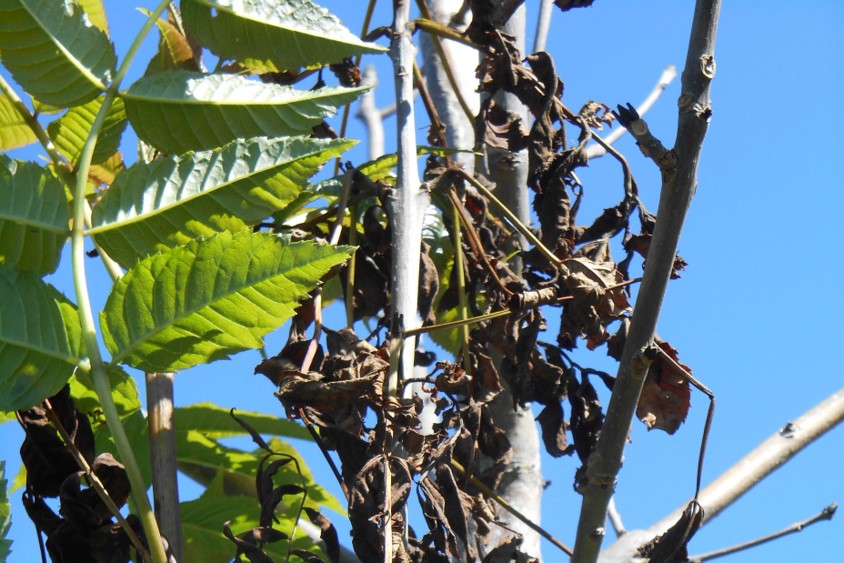
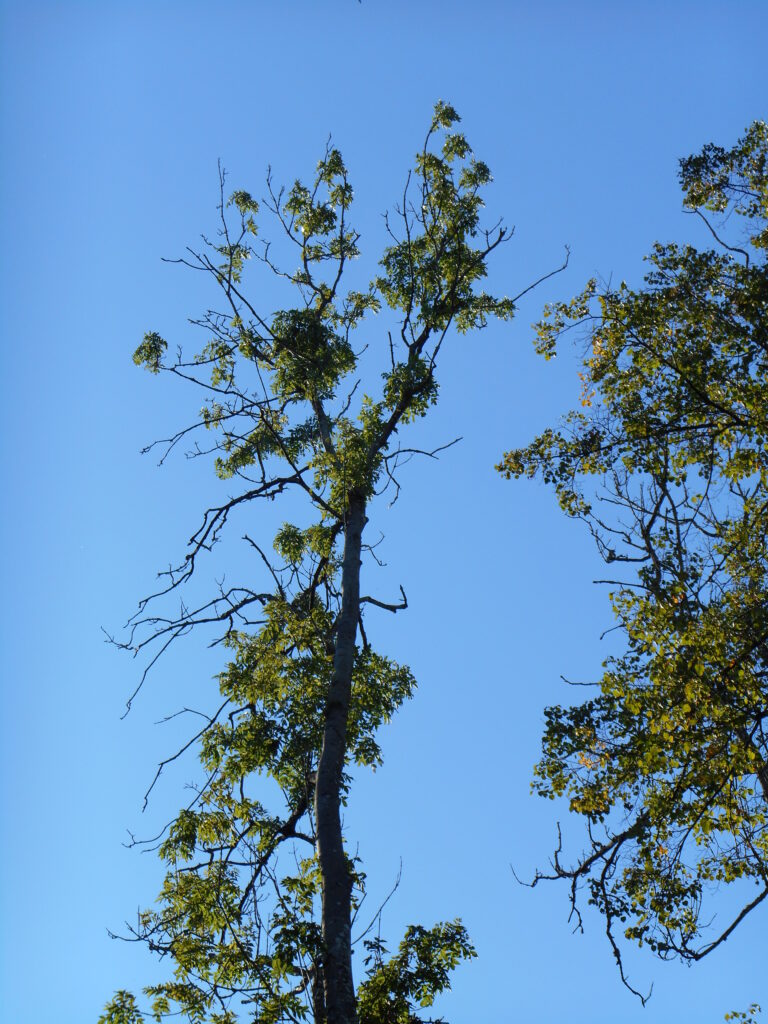
Impacts of Ash Dieback
The ecological importance of ash in the wider environment was previously unknown. Staff at the James Hutton, in collaboration with staff from the RSPB, The Royal Botanic Garden Edinburgh, Hodgetts consultants and Forest Research have found that ash fulfils a unique role in the functioning of our woods. Ash supports 955 species 45 of which only use ash (obligate) and 62 of which are highly associated with ash meaning they rarely use tree species other than ash. It is these 107 species that are most at risk from a decline in ash.
In comparison with other native deciduous tree species in the UK the functioning of ash is very different. Ash loses its leaves when they are green meaning the leaf litter contains high levels of nutrients and the leaf litter breaks down quickly. Replacement tree species are unlikely to have leaf litter with similar qualities. Thus if ash declines the nutrient cycling and ecosystem functioning of ash woodlands will change.
The ground flora within an ash woodland is also unique as ash casts a very light shade meaning many species can grow underneath it. If ash is replaced by other tree species with a darker shade than some ground flora species may decline.
Table showing the number of ash associated species and their level of association with ash:
| Group | Obligate | High | Partial | Cosmopolitan | Uses | Total |
| Bird | 7 | 5 | 12 | |||
| Bryophyte | 6 | 30 | 10 | 12 | 58 | |
| Fungi | 11 | 19 | 38 | 68 | ||
| Invertebrate | 30 | 24 | 37 | 19 | 131 | 241 |
| Lichen | 4 | 13 | 231 | 294 | 6 | 548 |
| Mammal | 1 | 2 | 25 | 28 | ||
| Total | 45 | 62 | 344 | 330 | 174 | 955 |
Tools to aid conservation of ash associated biodiversity
AshEcol is an excel file containing a list of all 955 ash associated species and information on if they do or not use 48 alternative tree species. The database is user friendly and aimed for woodland managers.
AshEcol allows managers to identify ash associated species and which alternative trees species they will also use. Management to encourage these alternative species either via planting or natural regeneration may help mitigate some of the impact of a decline in ash. Obviously there is no suitable management that will help mitigate impacts for species that only use ash.
AshEcol may be downloaded here
AshEcol has been used in case studies at 15 sites across the UK to assess how woodland management could change if ash dieback established at these sites and the aim was to conserve as much ash associated biodiversity as possible.
Key contact

Hutton team members
External Team:
- Forest Research: Ms Alice Broome, Mr Duncan Ray
- Hodgetts Botanical Services: Mr Nick Hodgetts
- RSPB: Dr Paul Bellamy
- Royal Botanic Garden Edinburgh: Dr Chris Ellis
- University of Cambridge: Dr Nick Littlewood
Oak decline
We have done similar work on the ecological impacts of a decline in oak. Click here for more information.
Publications
- Broome, A., Ray, D., Mitchell, R., Harmer, R., 2019. Responding to ash dieback (Hymenoscyphus fraxineus) in the UK: woodland composition and replacement tree species. Forestry. 92, 108-119 https://doi.org/10.1093/forestry/cpy040
- Mitchell R.J. , Broome A., Beaton J.K., Bellamy P.E., Ellis C.J., Hester A.J., Hodgetts N.G., Iason G.R., Littlewood N.A., Newey S., Pozsgai G., Ramsay S., Riach D., Stockan J.A., Taylor A.F.S., Woodward S. (2017) Challenges in assessing the ecological impacts of tree diseases and mitigation measures: the case of Hymenoscyphus fraxineus and Fraxinus excelsior. Baltic Forestry 23 116-140 https://www.slu.se/globalassets/ew/org/inst/mykopat/forskning/stenlid/advances-in-ash-dieback-research.pdf
- Broome, A.,Mitchell, R.J., 2017. Ecological impacts of ash dieback and mitigation methods, Forest Commision Research Note 029. Forest Research. https://www.forestry.gov.uk/PDF/FCRN029.pdf/$FILE/FCRN029.pdf
- Henry R.C., Palmer S.C.F., Watts K., Mitchell R.J., Atkinson N., Travis J.M.J. (2017) Tree loss impacts on ecological connectivity: developing models for assessment, Ecological Informatics, 42, 90-99
- Mitchell, R.J., Hewison, R.L., Hester, A.J., Broome, A. Kirby, K.J. (2016) Potential impacts of the loss of Fraxinus excelsior due to ash dieback on woodland vegetation in Great Britain. New Journal of Botany, 6, 2-15.
- Mitchell, R.J., Pakeman, R.J., Broome, A, Beaton, J.K., Bellamy, P.E., Brooker, R.W., Ellis, C.J., Hester, A.J., Hodgetts N.G., Iason, G.R., Littlewood, N.A., Pozsgai, G., Ramsay, S., Riach, D., Stockan, J.A., Taylor, A.F.S. and Woodward, S. (2016). How to replicate the functions and biodiversity of a threatened tree species? The case of Fraxinus excelsior in Britain. Ecosystems, 19, 573-596 (doi:10.1007/s10021-015-9953-y)
- Littlewood, N.A., Nau, B,S, Pozsgai, G, Stockan, J.A., Stubbs, A., Young, M.R. (2015) Invertebrate species at risk from Ash Dieback in the UK. Journal of Insect Conservation, 19, 75-85
- Mitchell, R.J., Beaton, J.K., Bellamy, P.E., Broome, A., Chetcuti, J., Eaton, S., Ellis, C.J., Gimona, A., Harmer, R., Hester, A.J., Hewison, R.L., Hodgetts, N.G., Iason, G.R., Kerr, G., Littlewood, N.A., Newey, S., Potts, J.M., Pozsgai, G., Ray, D., Sim, D.A., Stockan, J.A., Taylor, A.F.S. and Woodward, S. (2014) Ash dieback in the UK: a review of the ecological and conservation implications and potential management options. Biological Conservation, 175, 95-109
- Mitchell, R.J., Broome, A., Harmer, R., Beaton, J.K., Bellamy, P.E., Brooker, R.W., Duncan, R., Ellis, C.J., Hester, A.J., Hodgetts, N.G., Iason, G.R., Littlewood, N.A., Mackinnon, M. Pakeman, R., Pozsgai, G., Ramsey, S., Riach, D., Stockan, J.A., Taylor, A.F.S. & Woodward, S. 2014. Assessing and addressing the impacts of ash dieback on UK woodlands and trees of conservation importance (Phase 2). Natural England Commissioned Reports, Number 151. http://publications.naturalengland.org.uk/publication/5273931279761408
- Mitchell, R.J., Bailey, S., Beaton, J.K., Bellamy, P.E., Brooker, R.W., Broome, A., Chetcuti, J., Eaton, S., Ellis, C.J., Farren, J., Gimona, A., Goldberg, E., Hall, J., Harmer, R., Hester, A.J., Hewison, R.L., Hodgetts, N.G., Hooper, R.J., Howe, L., Iason, G.R., Kerr, G., Littlewood, N.A., Morgan, V., Newey, S., Potts, J.M., Pozsgai, G., Ray, D., Sim, D.A., Stockan, J.A., Taylor, A.F.S. & Woodward, S. 2014. The potential ecological impact of ash dieback in the UK. JNCC Report No. 483 http://jncc.defra.gov.uk/page-6459