HydroGlen
A scalable green hydrogen model supporting rural net-zero transition
HydroGlen is a multi- million green hydrogen–powered farming community pilot in northeast Scotland, funded by the Scottish Government’s Just Transition Fund. The project is developing a scalable and replicable model to support farming and rural communities in transitioning to low-carbon energy systems. Construction is expected to complete in November 2026.
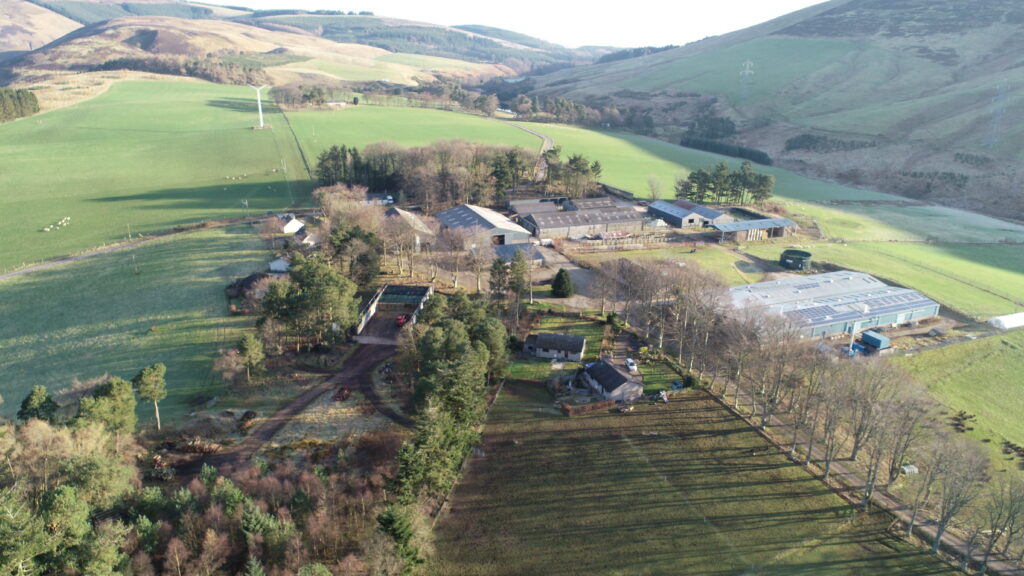
HydroGlen forms part of the James Hutton Institute’s Climate-Positive Farming Initiative, based at the Glensaugh Research Farm and residential community.
About HydroGlen
A technical feasibility study was carried out in 2021 after JHI received a grant from the Scottish Government’s Community and Renewable Energy Scheme (CARES), which demonstrated technical and regulatory feasibility of a farm-scale renewable energy green hydrogen system, utilising a combination of renewable electricity, on-site hydrogen production, compression, and storage.
This pilot project will provide a first-of-its-kind demonstrator and replicable model for green hydrogen-powered farming communities across Scotland and UK, showcasing a pathway to move from fossil fuel reliance to become self-reliant, net-zero carbon energy producers and exporters, generating 100%+ of their electricity, heating and transport fuel energy requirements renewably. Farmers and farmer cooperatives can visit, acquire new knowledge and replicate, reducing their own reliance on grid energy, which will increase their resilience against the volatility of energy prices, potential energy outages and/or shortages. This in turn will be highly beneficial for food security in the UK.
By being a first adopter, north-east Scotland’s expertise and businesses will be best placed to export know-how and technology to other regions to amplify energy security, green job creation and knowledge development.
HydroGlen has four key demonstration elements:
- “Build ready” – Commercially available technologies: HydroGlen utilises “on-the-shelf” technical components that are readily available within the market, allowing easy sourcing of components by other seeking to replicate the HydroGlen model.
- Hydrogen and Electric Vehicle combinations: HydroGlen, as part of its role as a demonstrator project, will showcase a mix of vehicle types, EV and H2, utilising the mixed-model energy system provided by HydroGlen with both hydrogen refuelling and EV charging facilities, allowing flexibility in vehicle choices as technologies continue to develop.
- Replicability – both on- and off-grid: HydroGlen is a grid-connected hydrogen system (providing back-up power for a predicted small percentage of annual use), but in the feasibility study report both on- and off-grid models were formulated. Demand for off-grid hydrogen production systems is likely in several of the more remote areas of the country and the learnings from HydroGlen are aimed to be sufficiently detailed to inform the needs of both on- and off-grid systems.
- Modular and scalable: HydroGlen is deliberately designed to be both modular and scalable, giving maximum relevance to others seeking to develop larger or smaller systems to suit their own energy requirements. HydroGlen, too, has been specifically designed on site to readily be scaled-up in future should this be required.
These four elements are considered critical to demonstrate and inform the roll-out of further farm and rural community scale green hydrogen systems across Scotland, in support of the Scottish Government’s Hydrogen production targets. The agricultural sector is anticipated to play a key role in developing future “Hydrogen hubs” as important components in helping to reduce Scotland’s greenhouse gas emissions.
Contact for more information
Alison Hester
Senior Scientist and Baillie Gifford Entrepreneurial Research Fellow
Based in Aberdeen
T: +44 (0)344 928 5428 (*)
Professor Alison Hester FRSB FRSGS is a senior scientist and Baillie Gifford Entrepreneurial Research Fellow at the James Hutton Institute, UK. She did her Degree at King’s College University of London, PhD at Aberdeen University/CEH and a Royal Society Postdoctoral Fellowship at CSIRO Western Australia. Alison has over 30 years research experience (with c200 scientific publications and contract reports) and an international reputation in biodiversity, conservation and land management. Much of her research forms an integral part of large, interdisciplinary projects and she works closely with scientists, land managers, communities and policy-makers in different parts of the world. In recent years she has taken a lead role in bringing together and managing diverse teams of scientists in the highly interdisciplinary research area of natural capital and Ecosystem Services, both within the institute and through a range of international collaborations.