Championing agricultural science through The James Hutton Institute and the International Barley Hub
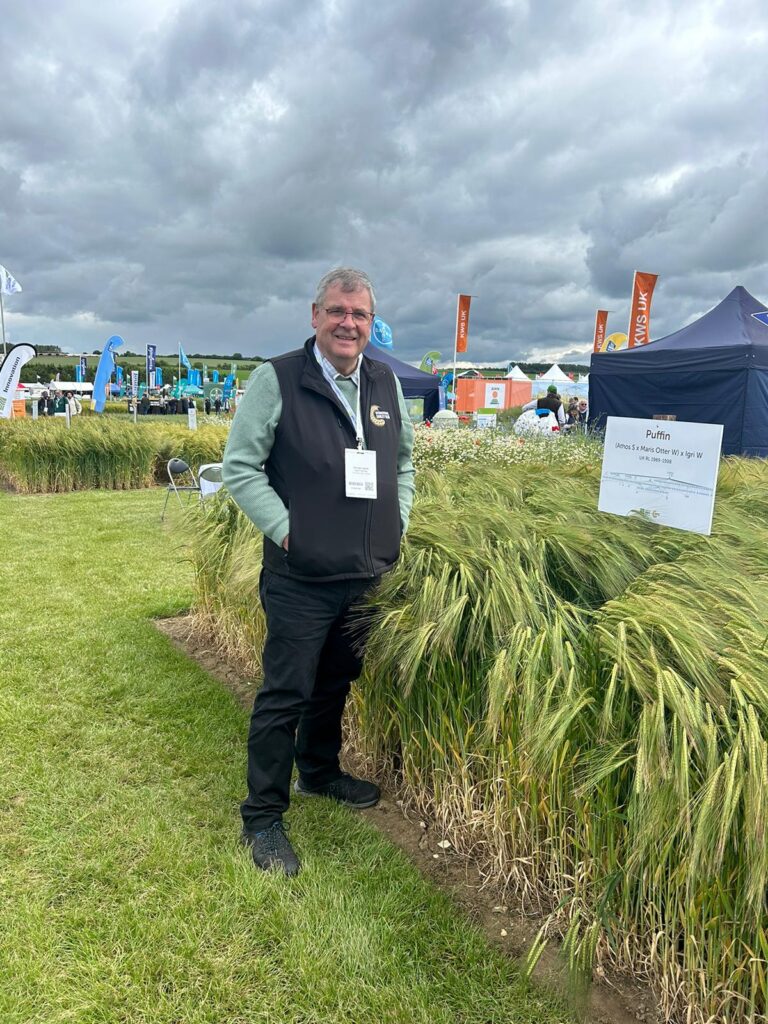
The end of this year will mark a significant milestone for me as I step down as Chair of the International Barley Hub. Combined with the completion of my nine-year term as a non-executive member of the James Hutton Institute Board earlier this year, it feels like the right time to reflect on a journey that has been shaped by a lifelong passion for agriculture, innovation and supporting the next generation.
My entire working life has been devoted to agriculture. My family has farmed in the Kinross area since 1955, so after studying at Elmwood College in Cupar, I started work on the family farm. Between 1989 and 2009 I ran my own farm in partnership with my wife, growing 350 hectares of cereals for the seed and malting market and 50 hectares of grass, producing hay and haylage for horses.
Throughout my career, I have always been driven by a desire to help move the industry forward. I have been fortunate to serve with a number of organisations, including NFU Scotland, the Agriculture and Horticulture Development Board (AHDB), the Royal Highland Educational Trust (RHET), the Scottish Society for Crop Research (SSCR), RSABI, founded as the Royal Scottish Agricultural Benevolent Institution), Paths for All and Scottish Agronomy, all of which have played important roles in supporting Scottish agriculture and rural communities.
One thing I have always believed is that young people deserve the very best opportunities to enter our industry and thrive. Agriculture has given me so much over the years, and I have always tried to give young folk a step up the ladder wherever possible. The future of our industry depends on their enthusiasm, skills and fresh ideas.
Why did I want to work with the Hutton?
As a farmer, I was always interested in modern technology and keen to try new approaches. I firmly believe that farmers need access to the best advice if they are to remain competitive, and that advice must be built on world-class research. Just as importantly, there must be a strong connection between researchers, farmers and consumers. Research must be relevant to the challenges farmers face while also meeting society’s expectations of food production. That belief is what drew me so strongly towards the work of The James Hutton Institute.
The International Barley Hub
Although I had known about the Hutton for many years through previous industry roles, I became much more closely involved through the development of what would become the International Barley Hub. Back in 2014, a small group of us began asking whether Scotland could create a centre of excellence for barley. At the time, I was representing NFU Scotland and was involved in some of the earliest discussions aimed at bringing together the entire barley supply chain.
Barley was the obvious focus. It is Scotland’s largest crop and absolutely vital to our world-renowned whisky industry. We recognised that if we could get farmers, breeders, researchers, processors and end users working together, we could achieve something truly transformative.
Those early conversations eventually evolved into the International Barley Hub (IBH), a project that holds a very special place in my heart. I have been involved from the very beginning and was delighted to be elected Chair in 2022. Today, the IBH stands as a unique platform dedicated to translating barley research into commercial benefits for industry, backed by a £62 million investment through the Tay Cities Region Deal (TCRD).
The James Hutton Institute Board
I was honoured to be appointed as a non-executive member of the James Hutton Institute Board in April 2017. I served until April this year and have had a fascinating insight into the inner workings of one of Scotland’s leading research organisations.
The Hutton Board members, acting collectively, are responsible for ensuring that the objectives of the Institute are met. The Board approves the strategic direction of the Institute and creates an environment in which its aims are achieved and its potential realised.
I joined as part of a group of three new non-executive directors who were the first to come onto the Board after the merger of the Macaulay Land Use Research Institute and Scottish Crop Research Institute. We brought fresh perspectives and, in my case, a practical farming background. I always saw my role as helping to ensure that the science remained connected to the realities of working farms and that research outputs could be translated into practical benefits for the industry.
During my time on the Board, we faced some significant challenges and important decisions. One of the first was determining whether the Hutton still needed major research sites in both Invergowrie and Aberdeen. Following a feasibility study, we concluded that both sites remained vital to delivering the breadth of research required. However, we did identify opportunities to centralise communications and finance while maintaining scientific excellence at both locations.
Another major decision concerned the Hutton’s farms. We assessed whether we were making the best use of all four sites and ultimately decided to return the tenancy of Hartwood Farm to the Scottish Government. It was primarily a grassland and livestock farm and was not being used to its full potential for crop research. By focusing activity at the three remaining farms, Mylnfield, Balruddery and Glensaugh, we were able to strengthen and streamline our research efforts.
A particular highlight
One of the most exciting periods of my Board service came with the development of the TCRD projects. The IBH had already been developed as a proposal and was effectively shovel-ready after previously missing out on other funding opportunities, but we recognised the potential to combine it with a new concept, the Advanced Plant Growth Centre (APGC). The TCRD agreed and granted funding for the two projects together in the new Crop Innovation Centre.
I subsequently became the Hutton Board representative on the TCRD development board and had a front-row seat as the vision became reality.
Watching the IBH take shape was one of the most rewarding experiences of my career, such an interesting process. My most memorable moment was seeing construction begin and the first bricks go into the ground. After years of planning and discussion, it was the point where an idea became something tangible. The whole Invergowrie site was transformed.
The project was not without its challenges. We had to accommodate around 500 employees while integrating new facilities, desk space and public engagement areas. There were countless decisions about how best to use the space and maximise both its scientific and commercial potential. Seeing staff and Board members work together to overcome those challenges and re-imagine the site was truly inspiring.
I was also pleased to be involved in the Just Transition programme at the Aberdeen campus and have followed the HydroGlen project at Glensaugh with great interest. Projects like these demonstrate how agriculture can play a leading role in addressing some of society’s biggest challenges, including climate change and the transition to net-zero.
I also got great satisfaction from serving as the Health and Safety representative on the Board. At times this involved driving cultural change across the organisation. Improving practices around personal protective equipment, laboratory standards and workplace safety was not always straightforward, but it was essential. I am proud of the progress that has been made and of the strong health and safety culture that now exists across the Hutton.
Back to barley
As Chair of the IBH, my role has been to support the leadership team and represent the organisation at industry events, including Groundswell, the Royal Highland Show and many of our own stakeholder gatherings. One of the things I am most proud of is the way the IBH has brought the industry together. Our stakeholder events regularly bring representatives from across the entire barley value chain into the same room to share ideas and shape the future. When we first started, that level of collaboration was virtually unheard of.
The progress made in barley research over the last decade has been remarkable. Advances in genomics, breeding technologies and emerging areas such as gene editing have the potential to transform the crop even further in the years ahead. We are building stronger foundations for both productivity and sustainability.
I am also incredibly proud of the success of the BARIToNE programme, which has supported 42 PhD students dedicated to barley research. Those talented researchers represent the future of agricultural science and give me great confidence about what lies ahead.
Of course, challenges remain. Research funding pressures continue to be a concern, and maintaining investment in world-class science will always require us to be vigilant. If we want agriculture to meet the demands of the future, we cannot afford to lose momentum.
As I prepare to step away from these roles, I do so with immense pride in what has been achieved and enormous optimism about what comes next. The IBH has grown from an idea discussed around a table into a world-class facility. The Hutton continues to deliver research that matters. Most importantly, a new generation of scientists, farmers and industry leaders is ready to take the sector forward.
It has been a privilege to play a part in that journey.
There’s more
I may have stepped down from the Board and be about to pass on the role of IBH Chair to my successor, but I am glad to say I have not said a final goodbye to the Hutton. I am now serving on the Philanthropy Board and am thrilled to have been given the opportunity to become an Honourary Fellow.
Blog by George Lawrie
Disclaimer: The views expressed in this blog post are the views of the author, and not an official position of the Hutton or funder.