The James Hutton Institute leads €6 million EU project to transform agricultural greenhouse gas monitoring
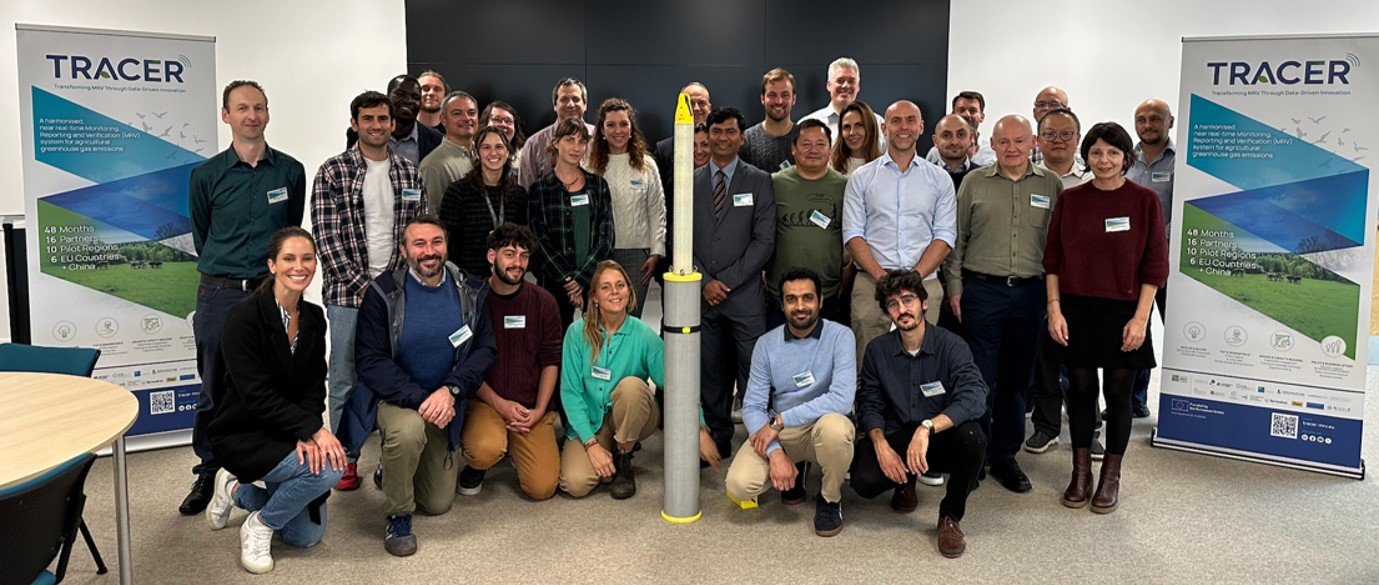
A new international research and innovation project coordinated by The James Hutton Institute aims to enhance the accuracy and transparency of agricultural greenhouse gas monitoring, reporting and verification (MRV) through the integration of near real-time measurements, satellite data and advanced modelling techniques.
TRACER (Transparent Reporting and Accountability for Carbon and non-CO₂ Emissions with Real-time Data Streams and Advanced Modelling) brings together 16 partners from Europe and China in a four-year programme to improve how agricultural greenhouse gas emissions are measured, reported and verified.
Agriculture is a significant source of non-CO₂ greenhouse gases, particularly methane (CH₄) and nitrous oxide (N₂O), generated through activities such as livestock production, soil management and fertiliser use. However, accurately measuring or estimating these emissions remains challenging because they vary according to farming practices, environmental conditions and agricultural systems.
“Our long-term vision is to help accelerate the transition to a climate-resilient agricultural sector, supporting meaningful emissions reductions and contributing to global climate goals.”
Dr Jagadeesh Yeluripati, The James Hutton Institute
Project Coordinator, Dr Jagadeesh Yeluripati of the Hutton, said, “By combining real-time data from field with advanced modelling, TRACER will deliver a transparent and robust system to support monitoring, reporting and verification across Europe. This will enable policymakers and stakeholders to make more informed, evidence-based decisions. Our long-term vision is to help accelerate the transition to a climate-resilient agricultural sector, supporting meaningful emissions reductions and contributing to global climate goals.”
The system will be tested and validated at ten pilot sites, nine across Europe and one in China, representing a range of farming systems and climates. It will also be demonstrated on commercial farms through five Living Labs, where farmers, advisers, researchers, policymakers and industry representatives will work together to assess its practical application.
By combining scientific measurements with real-world demonstrations, TRACER aims to deliver robust and practical monitoring solutions that support evidence-based policymaking, contribute to European initiatives such as the Common Agricultural Policy (CAP) and Carbon Removals and Carbon Farming Certification Framework (CRCF), and help accelerate the transition to more sustainable and climate-resilient agriculture.
To learn more about TRACER and subscribe to the project newsletter, visit TRACER MRV or watch the video of the project’s kick-off meeting.