Understanding of rural communities’ vulnerability and risk perceptions to water scarcity and variable water quality.
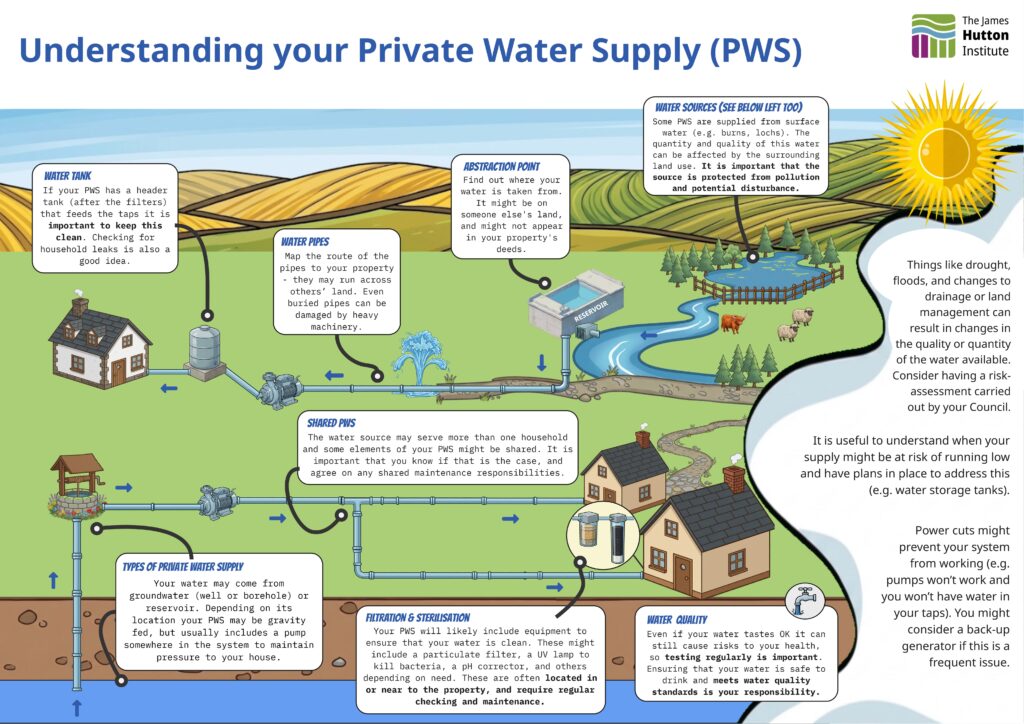
Infographic describing components of Private Water Supply systems. Source: Emerging Water Futures Deliverable 4.2
About the project
Rural drinking water is one area of supply that is significantly impacted by the emerging threats to Scotland’s water resources and services that are posed by pollution and contamination, low levels of user awareness, and climate change impacts. Users and managers of these supplies must contend with the increased regularity of low flow conditions and drought, health and social impacts of poor drinking water quality, as well as the need to respond to changing policy and regulatory environments. Although these impacts play out across multiple scales, rural households and businesses dependent on private water supplies (PWS) experience these challenges in very material ways and often find themselves tasked with developing coping strategies and innovating in the face of growing uncertainty. As such, rural PWSs are an appropriate case study for examining: the socio-economic factors that amplify/mitigate vulnerability to water shortages and water quality issues, attitudes and perceptions of risk associated with water supplies, and the feasibility of self-monitoring to support a wider self-supply management model.
Building on existing understandings of biophysical risk to rural PWS, our approach adopts an intersectional social justice framing that explores relational vulnerability across deprivation, housing insecurity, disconnection, and minority groups in rural and island areas. Specific focus is placed on well-being, resilience of rural communities, economic activity, and wealth creation in rural places.
Our research also identifies key determinants that impact risk perception (experiences of scarcity and quality issues, agency contact, informal knowledge sharing and networks, affective assessments). Household and community scale barriers (primarily risk perception, socio-economic factors, and attitudes and values associated with water), as well as institutional barriers (access to information and advice, existing knowledge sharing networks, impacts of short-term relief support packages, and financial barriers) are examined.
Using qualitative social sciences methods, we contribute to building an interdisciplinary understanding of the risks, impacts, and responses that arise from growing uncertainty and variability in drinking water supplies/quality. We identify key determinants that impact risk perception (experiences of scarcity and quality issues, agency contact, informal knowledge sharing and networks, affective assessments). Household and community scale barriers (primarily risk perception, socio-economic factors, and attitudes and values associated with water), as well as institutional barriers (access to information and advice, existing knowledge sharing networks, impacts of short-term relief support packages, and financial barriers) are examined. In the final phase, we utilise a participatory approach to explore how households play their part in becoming resilient to water-related climate impacts.
Aims and objectives
- Review existing evidence about private water supplies (PWS) in Scotland.
- Develop a qualitative understanding of rural communities’ vulnerability to and experiences of water insecurity.
- Explore how risk awareness and perceptions of water scarcity function as barriers to and drivers of individual and community behaviour change and innovation.
- Hold a series of rural Water Security workshops to bring together PWS users, share preliminary findings, and explore opportunities for the creation of a PWS network.
- Provide recommendations to social learning and networks to enhance resilience of rural PWS.
Principle investigator

Team members
Colleagues previously involved
This project is funded by the Scottish Government RESAS Strategic Research Programme (SRP) 2022-27.
It corresponds to activities 4.1 and 4.2 in WP4 (“Increasing resilience of drinking water supplies”) of ‘JHI-D2-1’ within the Natural resources Theme.
The main project page can be found here.
Update on research activities
The research team has been busy in recent months working on the analysis of data collected over the first years of the project. This data collection has included:
- a survey of private water supply users across Scotland
- a series of qualitative interviews with PWS users in the North East and South West of Scotland
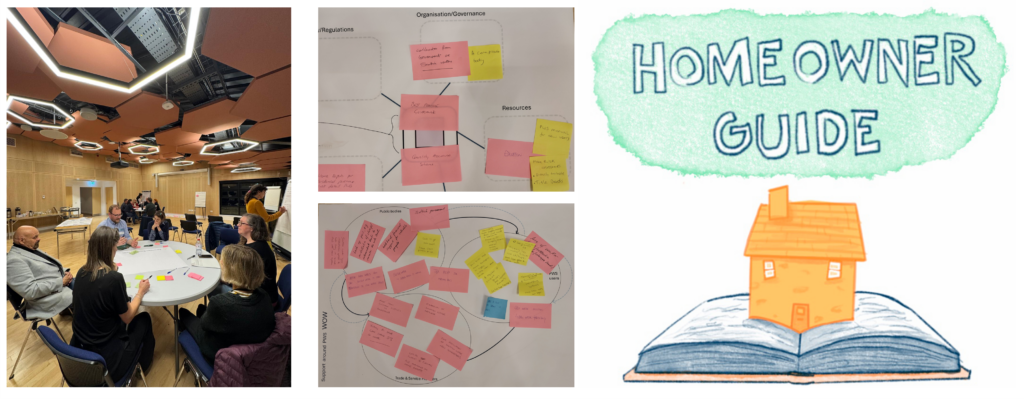
- a series of workshops held across North East and South West Scotland, and online, featuring participants working in institutions involved in the governance of PWS, PWS service providers and PWS users.
We’d like to thank all the participants involved in our data collection activities who have generously shared their time, knowledge and experience to enrich our understanding of the topic.
Building on this research, we have produced a leaflet guide for PWS users featuring information on understanding and looking after their PWS, and signposting to sources of further information and support. Local Authorities might find this resource useful for sharing with PWS users in their areas. You can access this leaflet here, and more detailed information here.
In the last year of the project, we plan to produce further outputs, including a policy brief describing stakeholders’ recommendations for improving support for PWS users.
Outputs from this research
Blogs, brochures and briefings
- What is a Private Water Supply? A guide for users. March 2026.
- Brochure describing key aspects of private water supplies signposting where to find further information and specific guidance.
- What is a Private Water Supply? A guide for users (Web version). March 2026.
- Guidance describing key aspects of private water supplies signposting where to find further information and specific guidance, with more detailed information than the brochure.
- Perceived risks and concerns among Private Water Supply users. June 2025.
- Brief about key results from our 2024 exploratory survey with private water supply users. [To link the title of the brief
- Water security and Private Water Supplies. March 2025.
- Blog post and collection of resources for the Hydro Nation International Centre World Water Day Hub 2025.
Conference presentations and posters
- In November 2025, Katy Joyce presented a poster about our research and preliminary results at the Hutton Symposium. Click here to download the poster.
- In October 2025, Diana Valero was an invited stallholder in the Aberdeen City and Aberdeenshire Community Resilience Conference where we had a poster with insights about the situation of PWS in the North East of Scotland. Click here to download the poster.
- In August 2024 , Keith Marshall presented insights from our survey of PWS users at the annual RGS-IBG Annual International Conference in a session dedicated to explore water insecurities in Europe. Click here to download the slides.
- In June 2024, Diana Valero presented insights from our join research with the MDT Fellowship on rural water security about the impacts of storms on water security at the 10th Nordic Geographers Meeting in Copenhagen. Click here to download the slides.
Academic papers and project reports
Some of these outputs derive wholly from work carried out in this project and some arise from collaborations with other researchers and research initiatives. Some project deliverables are not linked here while we prepare academic outputs for publication – but please contact us if there is an area of work that you would like to know more about.
This research started in April 2022 and runs until March 2027
The team is developing follow-up research on water insecurity across PWS and mains households in the project WISE4Forth. For more information about this project, contact Diana Valero.
Results of this study have fed into the Scottish Rural Action’s “Rural Water Agenda” initiative.
Members of our team were also involved in related research as part of the MDT Fellowship on Rural Water Security 2021-2024.