Professor Robbie Waugh receives prestigious international genetics honour
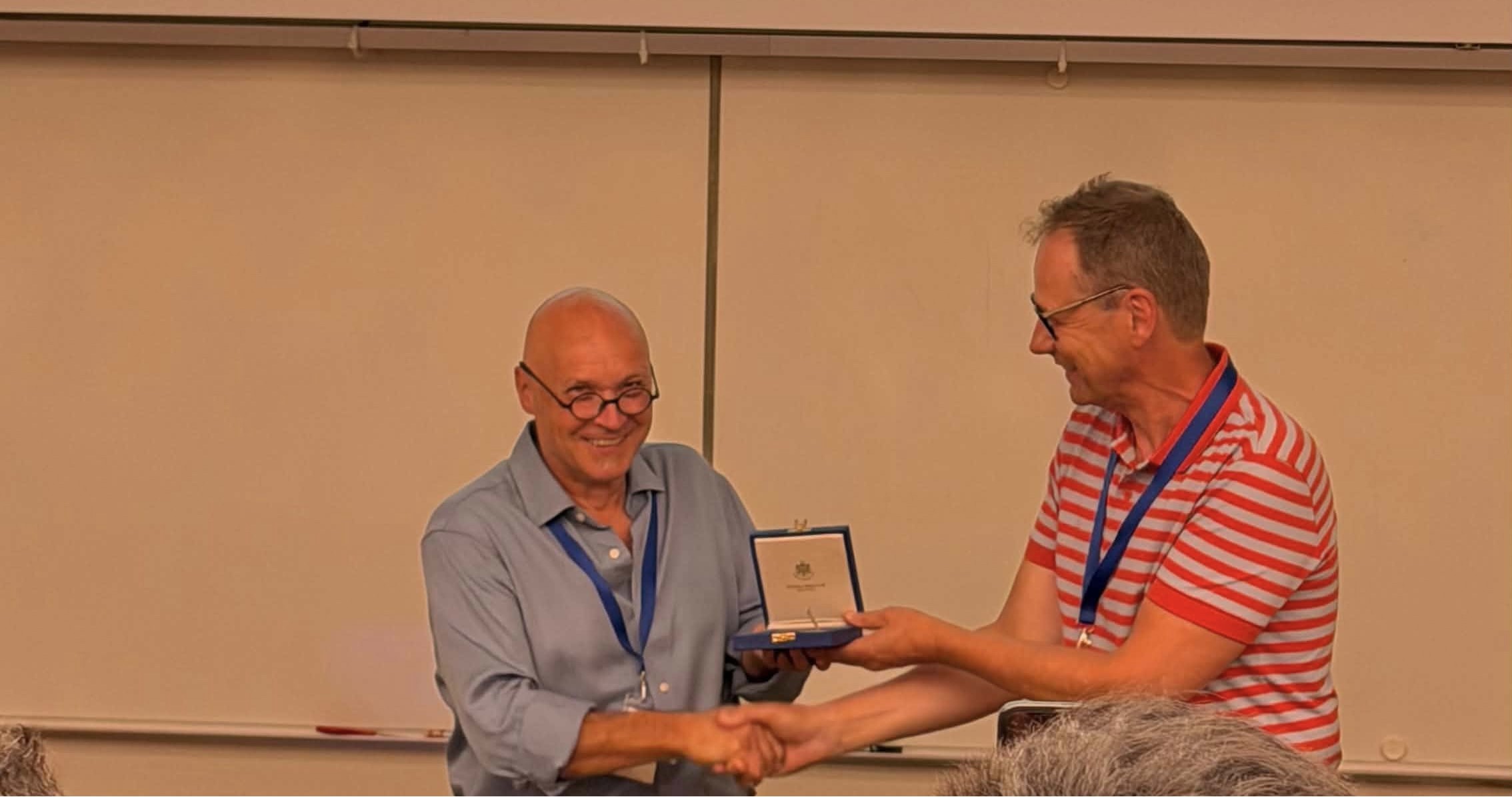
The James Hutton Institute is delighted to announce that Professor Robbie Waugh, former Director of its International Barley Hub (IBH) and now a Hutton Fellow, has been awarded the Royal Physiographic and Mendalian Societies in Lund Honorary Lecture in Genetics medal.
Presented at the 4th International Barley Mutant Workshop at Lund University, Sweden, the annual award recognises major international contributions to genomics and heredity and is regarded as one of the most distinguished accolades in genetics research.
As part of the award, Professor Waugh delivered the honorary lecture, A Tale of Variation in Spike Density, Culm Length and Open Flowering, highlighting research into genetic mechanisms that influence barley growth, development and crop performance.
“Over my career I have benefitted enormously from interactions with some exceptional Scandinavian barley researchers, so being awarded the medal in Sweden was a special honour.”
Professor Robbie Waugh, Hutton Fellow
Presenting the medal, Professor Mats Hansson of Lund University said, “Professor Robbie Waugh is awarded The Royal Physiographic and Mendelian Societies in Lund Honorary Lecture in Genetics medal in recognition of his pioneering contributions to cereal genomics. His work has helped establish barley as a major model system, including the development of foundational barley genome resources.
Professor Waugh responded, “I am delighted to have been awarded this medal, and to be following in the footsteps of so many notable scientists.
“My scientific achievements would not have been possible without all the great work of colleagues at home and further afield. Over my career I have benefitted enormously from interactions with some exceptional Scandinavian barley researchers, so being awarded the medal in Sweden was a special honour.”
Professor Waugh’s lecture explored how thousands of years of domestication and crop breeding have shaped barley varieties with desirable characteristics such as shorter stems, denser grain-bearing spikes and flowering traits that improve productivity and environmental adaptation.
His research focuses on identifying the genes responsible for these key agricultural traits. By combining advanced genomic technologies with extensive collections of naturally occurring and induced barley mutants, scientists have been able to uncover many of the genetic mechanisms controlling plant architecture and development. These historic mutant collections, established by pioneering plant geneticists over the past century, continue to provide invaluable insights into crop biology.
The presentation highlighted new findings on the genetic control of three closely related traits: spike density, stem length and flowering behaviour. Earlier studies identified mutations in the HvAP2 gene that result in barley plants with dense spikes and closed flowers.
Professor Waugh’s latest research has characterised a different mutant with similarly dense spikes but normal flower opening, demonstrating that these traits can be controlled independently through distinct genetic pathways operating at different stages of plant development.