James Hutton Institute
 
  • Science
    • Our science
    • Research themes
    • Innovation centres
    • Science departments
    • Research projects
    • Postgraduate school
  • Scientific services
    • Our services
    • Analytical
    • Crop production
    • Research collaborations
    • How to work with us
  • Impact
    • Our impact
    • Open science
  • Resources
    • Blogs
    • Case studies
    • Hutton podcast
    • Hutton Highlights
    • Research projects
    • Soil data and maps
  • Latest
    • Events
    • News
    • Opportunities
  • About
    • About us
    • Who we are
    • Our people
    • Organisational structure, leadership and governance
    • Our history
    • Accreditation
    • Research integrity
  • Venue
    • Venue hire
    • Glensaugh campus
    • Invergowrie campus
  • Contact
    • Contact us
  • News
  • What’s on
  • About
  • Opportunities
  • Contact
  • Venue Hire
  • Shop
  • Basket
Search for:
  • Science
        • Science

        • Our science
        • Research themes
          • Connecting land and people
          • Crop resilience and sustainability
          • Protecting and enhancing natural capital
        • Innovation centres
        • Science departments
        • Research projects
        • Our people
        • Postgraduate school
          • Growing beans before barley could cut farming’s environmental footprint

            Putting field beans into cereal rotations can reduce fertiliser use, lower environmental impacts and increase the yield of the barley crop that follows.

            Find out more >

            Growing beans before barley could cut farming’s environmental footprint
  • Scientific services
        • Scientific services

        • Analytical
        • Improving crop production
        • Research collaborations
        • How to work with us
  • Resources
        • Resources

        • Blogs
        • Case studies
        • Hutton podcast
        • Hutton Highlights
        • Research projects
        • Soil data and maps
          • From the Andes to Scotland: Exploring potato diversity for a climate-resilient future

            Some of the solutions to the challenges facing potato production may already exist in the remarkable potato diversity that farmers in the Andes have been conserving for generations

            Find out more >

            From the Andes to Scotland: Exploring potato diversity for a climate-resilient future
  • Impact
        • Impact

        • Our impact
        • Open science
          • SeaDyes: Scaling sustainable marine-derived dyes through scientific and commercial collaboration

            While marine-derived, nature-based dyes offer a promising alternative, developing them into consistent, reproducible and commercially viable products presents significant scientific and technical challenges.

            Find out more >

            SeaDyes: Scaling sustainable marine-derived dyes through scientific and commercial collaboration
  • Accommodation to lease
  • James Hutton Tercentenary
Home > News > Staff from The James Hutton Institute and SCAnDi put together the pieces of forensic education at Edinburgh Science Festival

Staff from The James Hutton Institute and SCAnDi put together the pieces of forensic education at Edinburgh Science Festival

23 April 2025

The James Hutton Institute was delighted to support Edinburgh Science Festival as a funding partner this year, with staff running two extremely well attended and successful events.

Professor Lorna Dawson, Head of the Centre for Forensic Soil Science at the Hutton, hosted both a hands-on workshop for children and an interactive evening lecture alongside colleagues from the single-cell and single molecule analysis for DNA identification (SCAnDi) project.

The project, which is being carried out by the Hutton in partnership with the Earlham Institute, the University of Edinburgh, the University of Portsmouth, the University of Derby, Liverpool John Moores University and Edge Hill University, examines whether new techniques in the single-cell analysis field could add valuable new DNA evidence to investigations when used by forensic investigators.

The two forensic education events focused on the techniques and methods used when gathering forensic evidence. In the children’s workshop, Solving a Crime, Brick by Brick, attendees were tasked with investigating a Lego crime scene and gathering evidence. Professor Dawson was joined by Dr Katherine Brown from the University of Portsmouth, Dr Georgios Zouganelis from the University of Derby and Dr Nick Dawnay from Liverpool John Moores University as they talked the ‘recruits’ through the crime scene and helped build DNA profiles of the suspects.

The workshop gave plenty of budding investigators a chance to try their hand at evidence-gathering and it proved to be a hit with both children and adults, who loved seeing the Lego crime scene and piecing together the clues of our mystery. Eric, aged 11, attended the workshop with his mum, and said afterward: “It was really fun – I liked searching for clues. I’m a big fan of problem solving, so I enjoyed it a lot.”

“It was an honour to be invited to participate in this year’s Edinburgh Science Festival. We were delighted to see so much interest in the work that we do, and we hope that we have sparked the curiosity of a few budding scientists of the future by engaging in such an interactive way.”

Professor Lorna Dawson, The James Hutton Institute
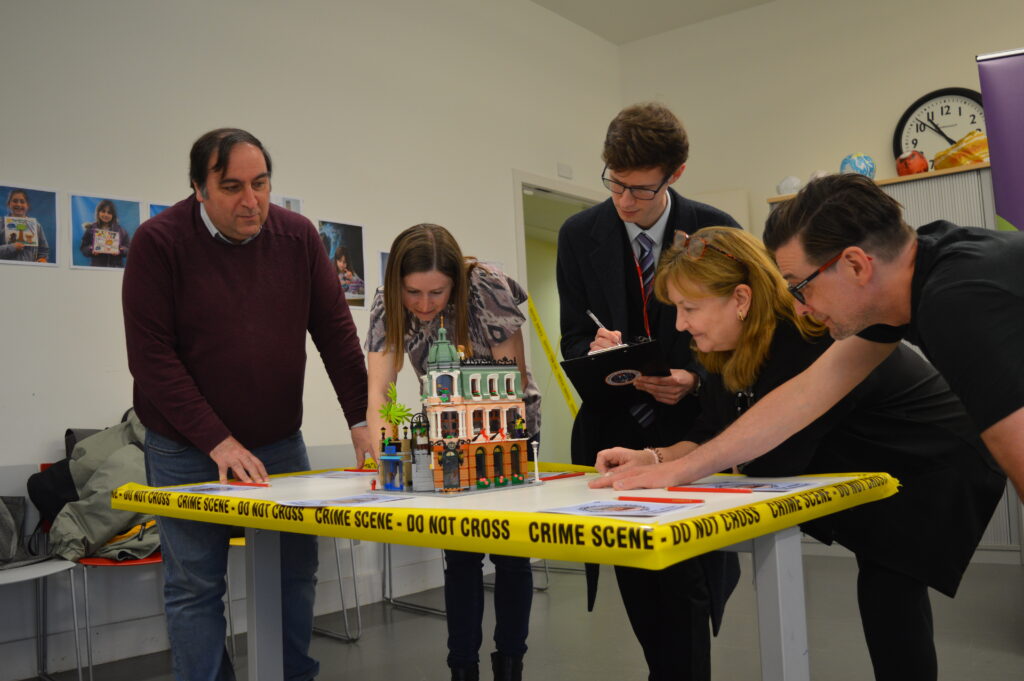
(L to R) Dr Georgios Zouganelis, Dr Katherine Brown, Andrew Jenkins, Dr Lorna Dawson and Dr Nick Dawnay investigating a Lego crime scene.
(L to R) Dr Lorna Dawson, Dr Nick Dawnay, Andrew Jenkins, Dr Katherine Brown and Dr Georgios Zouganelis ahead of the evening lecture.

Solving a Crime, Brick by Brick was followed by Extracting Evidence, an evening talk aimed at those aged 16 and above. Audience members were treated to a mock crime scene investigation, giving them a chance to learn about the work forensic scientists do. Topics included how forensic entomologists use insect lifecycles to establish a time of death, how soil science can help identify areas of search, how to sample at a crime scene and the methods used to extract DNA from secured evidence.

The mock investigation was followed by a Q and A session and a discussion of the SCAnDi project.

Both forensic education events were hosted by Andrew Jenkins, an events developer from Edinburgh Science.  

Speaking after the festival, Professor Lorna Dawson said: “It was an honour to be invited to participate in this year’s Edinburgh Science Festival. We were delighted to see so much interest in the work that we do, and we hope that we have sparked the curiosity of a few budding scientists of the future by engaging in such an interactive way.”

Feedback at both events was extremely positive and we hope to be able to repeat them in the future.

For more information, contact Media Officer, Matteo Bell, at matteo.bell@hutton.ac.uk or on 07494422228.

James Hutton Institute

Want to keep up to date with our research, news and events?

Subscribe to our quarterly e-magazine, Hutton Highlights.

The James Hutton Institute
Craigiebuckler
Aberdeen AB15 8QH
Scotland

The James Hutton Institute
Invergowrie
Dundee DD2 5DA
Scotland

Phone: +44 (0)344 928 5428
Email: info@hutton.ac.uk

Hutton Scientific Services
Phone: +44 (0)1382 568 568
Email: info@huttonltd.com


  • Privacy Policy
  • Accessibility
    • Modern Slavery Statement
  • Cookie Policy
  • ACCREDITATION
  • Staff Services
  • Freedom of Information
  • Data Protection/GDPR

A Scottish charitable company limited by guarantee. Registered in Scotland No SC374831. Registered office: The James Hutton Institute, Invergowrie Dundee DD2 5DA. Charity No SCO41796