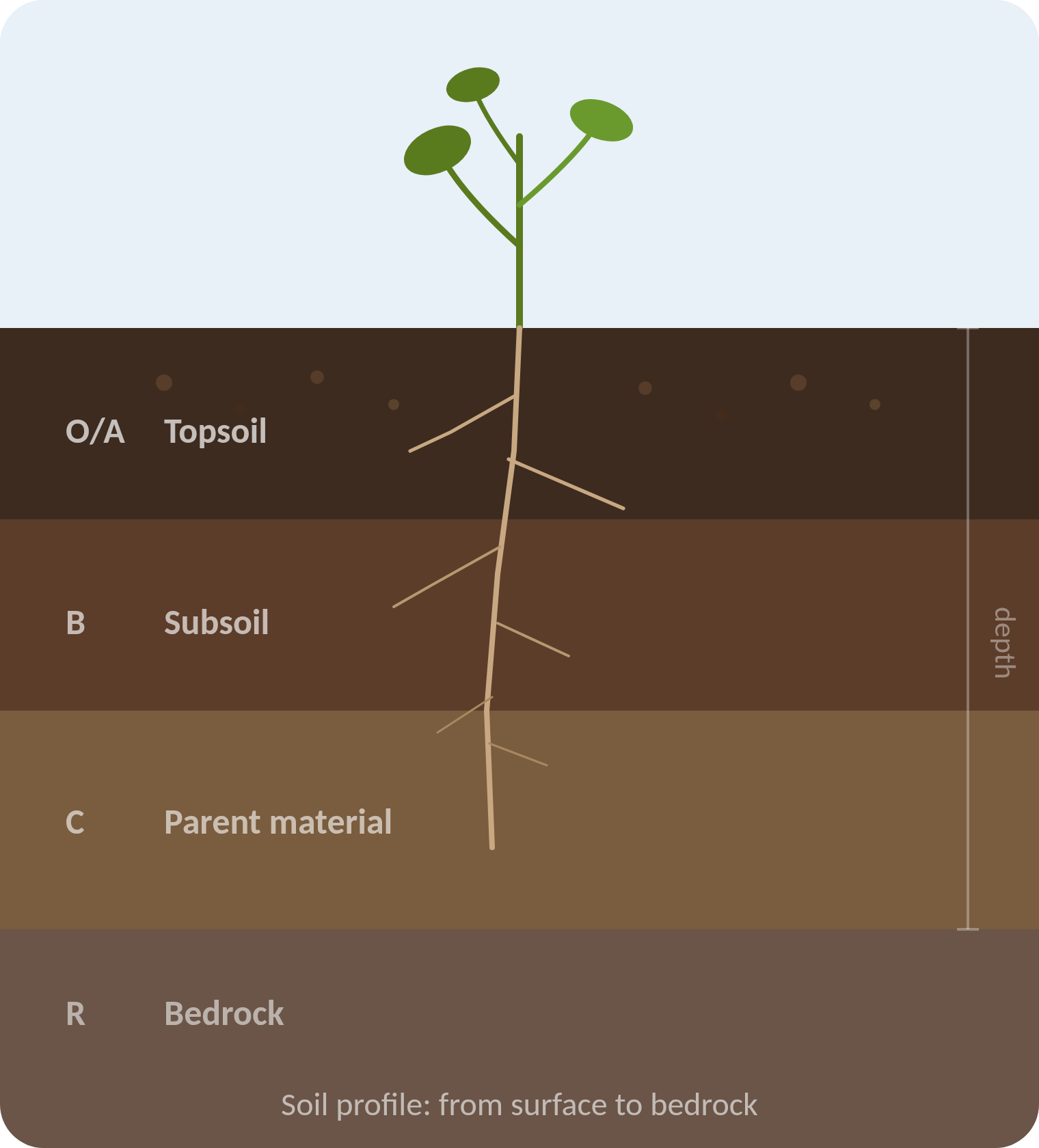
Healthy soil is the foundation of everything your farm produces
Most farms test for pH, nitrogen, phosphate and potassium. That’s a start, but it’s only part of the picture. The biological activity in your soil, its physical structure and its ability to hold water and nutrients are the factors that separate a good harvest from a great one, year after year.
Better yields and crop establishment
Healthy soils give crops the physical structure, biological activity and nutrient availability they need to get off to a strong start and keep performing through the season.
Resilience to drought and wet weather
Soil structure determines how well your land handles extremes. Good aggregate stability and water-holding capacity can make the difference when the weather turns against you.
Better returns on your inputs
When soil biology and chemistry are working together, nutrients go further. Understanding your soil’s cation exchange capacity and organic matter levels helps you apply inputs where they’ll actually make a difference.
Carbon storage and sustainability goals
Soil organic matter is one of the most powerful tools for carbon storage. Understanding and improving your soil’s carbon status supports sustainability commitments and positions your farm for future schemes.
The opportunity
Small changes. Big impact.
If your soil health isn’t where it should be, the good news is that meaningful improvements often start with straightforward actions. You just need to know where to look, and that’s exactly what Soils IQ is designed to tell you.
Know your baseline
You can’t manage what you can’t measure. Soils IQ gives you a clear, independently verified picture of where your soil stands today across physical, biological and chemical indicators, not just the basics.
Target your actions
With a whole-picture analysis, you stop guessing and start knowing. Whether it’s adjusting lime applications, evaluating cover crops, improving structure or fine-tuning fertiliser strategy, our reports show where effort will make the greatest difference.
Build for the future
Farms that understand their soils today are building a competitive advantage for tomorrow. Benchmarking your soil health now puts you ahead of the curve as sustainability expectations grow, rather than scrambling to catch up.
A note on Scope 3 emissions reporting
Soil health is increasingly part of the sustainability conversation for UK supply chains. Farms that act early, benchmarking and demonstrating improvement, will be in a far stronger position when reporting requirements arrive. Soils IQ gives you the independent, credible data to support those conversations.
Find out where your soil stands
Talk to our soil health team about the right starting point for your farm.
We guide you through the whole process, from choosing the right service level to understanding your results and knowing what to do next.
1
Choose your level
Select the Bronze, Silver or Gold service level that matches your goals, your land and your budget. Not sure? Speak to one of our experts and we’ll help you decide.
2
Sample your soil
We guide you on exactly how and where to take composite samples across each field, with a minimum of five samples per field. We recommend sampling every three to five years.
3
We analyse
Your samples are analysed by our accredited laboratory team using world-class instrumentation, with rigorous quality assurance at every stage.
4
Clear, actionable report
You receive a plain-English report with practical recommendations, not just numbers. Understand what your results mean, and exactly where to focus your efforts first.
Service levels
A service designed for every farm
Whether you’re just starting your soil health journey or looking for a comprehensive analysis programme, there’s a level that fits your needs and ambitions. Start where you are, and build as your understanding grows.
Bronze
Essential
A reliable starting point for informed soil management
Ideal for
Routine monitoring, compliance testing and entry-level soil health assessments
What you’ll learn
Whether soil chemistry is optimised for crop growth
Water stable aggregate assessment (large fraction), the percentage of aggregates stable after wet sieving
✓
✓
✓
Water stable aggregates, small fraction (associated with carbon storage)
✓
✓
Mean weight diameter of aggregates
✓
✓
Soil bulk density
✓
Water holding capacity
✓
Soil porosity (derived from specific gravity)
✓
Biological
Enzyme activity measure
✓
✓
✓
Chemistry
Soil pH
✓
✓
✓
Soil mineral nitrogen
✓
✓
✓
Phosphate, potassium and magnesium
✓
✓
✓
Soil organic matter
✓
✓
✓
C:N ratio (based on conversion of organic matter to carbon)
✓
✓
✓
Soil texture (particle size distribution)
✓
✓
✓
Electrical conductivity (salinity)
✓
✓
✓
Soil organic carbon
✓
✓
Cation exchange capacity (CEC)
✓
✓
Micronutrient profile
✓
✓
Reporting and extras
Plain-English results report with practical recommendations
✓
✓
✓
Benchmarking capability
✓
✓
✓
Guidance on composite sampling technique
✓
✓
✓
Integrated soil health score
✓
Soil archive stored at −80°C for future analysis as new technologies emerge
✓
Bespoke packages available on request
✓
✓
✓
Analysis is carried out on composite samples from each field, with a minimum of five samples per field. We recommend sampling every three to five years. Bespoke packages are also available, so get in touch to discuss your requirements.
“Soil health is about so much more than NPK. Understanding that means even small changes can deliver big results. Soils IQ gives you the independent, whole-picture analysis to make those changes with confidence.”
Gareth Newman, Business Development Manager, Hutton Scientific Services
Why Hutton Scientific Services
Independent. Credible. Actionable.
Soils IQ is delivered by Hutton Scientific Services, the commercial arm of the James Hutton Institute, one of the UK’s leading centres for soil and agricultural research.
Fully independent
We don’t sell fertiliser, agronomy services or inputs. Our only interest is giving you accurate, unbiased analysis you can act on with confidence.
Credible, accredited science
Backed by decades of soil and agronomy research from the Hutton, with laboratory services delivered to the highest standards, including ISO17025 accreditation where required. Results you can defend, for internal decisions or external reporting.
Actionable results
Every report comes in plain English with practical recommendations, not just numbers. You’ll know what your results mean and exactly where to focus first.
Get in touch
Ready to understand your soil?
Speak to one of our experts to find the right service level for your farm. No obligation, just honest advice.
ID used to identify users for 24 hours after last activity
24 hours
__utma
ID used to identify users and sessions
2 years after last activity
_gat
Used to monitor number of Google Analytics server requests when using Google Tag Manager
1 minute
__utmt
Used to monitor number of Google Analytics server requests
10 minutes
__utmb
Used to distinguish new sessions and visits. This cookie is set when the GA.js javascript library is loaded and there is no existing __utmb cookie. The cookie is updated every time data is sent to the Google Analytics server.
30 minutes after last activity
__utmc
Used only with old Urchin versions of Google Analytics and not with GA.js. Was used to distinguish between new sessions and visits at the end of a session.
End of session (browser)
__utmz
Contains information about the traffic source or campaign that directed user to the website. The cookie is set when the GA.js javascript is loaded and updated when data is sent to the Google Anaytics server
6 months after last activity
__utmv
Contains custom information set by the web developer via the _setCustomVar method in Google Analytics. This cookie is updated every time new data is sent to the Google Analytics server.
2 years after last activity
__utmx
Used to determine whether a user is included in an A / B or Multivariate test.
18 months
_ga
ID used to identify users
2 years
_gali
Used by Google Analytics to determine which links on a page are being clicked
30 seconds
_ga_
ID used to identify users
2 years
_gac_
Contains information related to marketing campaigns of the user. These are shared with Google AdWords / Google Ads when the Google Ads and Google Analytics accounts are linked together.
90 days
SourceBuster is used by WooCommerce for order attribution based on user source.
Name
Description
Duration
sbjs_session
The number of page views in this session and the current page path
30 minutes
sbjs_udata
Information about the visitor’s user agent, such as IP, the browser, and the device type
session
sbjs_first
Traffic origin information for the visitor’s first visit to your store (only applicable if the visitor returns before the session expires)
session
sbjs_current
Traffic origin information for the visitor’s current visit to your store
session
sbjs_first_add
Timestamp, referring URL, and entry page for your visitor’s first visit to your store (only applicable if the visitor returns before the session expires)
session
sbjs_current_add
Timestamp, referring URL, and entry page for your visitor’s current visit to your store
session
sbjs_migrations
Technical data to help with migrations between different versions of the tracking feature
session
Marketing cookies are used to follow visitors to websites. The intention is to show ads that are relevant and engaging to the individual user.
Name
Description
Duration
wp_consent_marketing
4 weeks
Google Tag Manager simplifies the management of marketing tags on your website without code changes.
Name
Description
Duration
cookiePreferences
Registers cookie preferences of a user
2 years
td
Registers statistical data on users' behaviour on the website. Used for internal analytics by the website operator.