Soil Analysis
Due to The James Hutton Institute’s extensive research experience for soil, James Hutton Institute Scientific Services is ideally positioned to offer a multidisciplinary service for soil analysis.
The soil analysis offered encompasses soil chemistry, physics, biology, and genomics and is well supported with technical and scientific expertise.
Soil Testing Services – 100 years of soil research experience
Soil analysis is a crucial process that involves the examination of soil properties to assess its health and suitability for intended land use and management. James Hutton Institute offers a suite of services including sampling, preparation, testing, project management, field scale trials and interpreting results. Suitable for both industrial, research, and private sector partners.
Soil Assessment – Carbon, Fertility, and Chemistry
Accredited laboratories assess the chemical and physical properties of soils, including pH, electrical conductivity, and fertility, to guide agronomic, horticultural, and conservation efforts. Key chemical aspects include the evaluation of macro and micronutrients, cation exchange capacity (CEC), base saturation, and potential contaminants like heavy metals and hydrocarbons. Particle size distribution is determined using laser diffraction.
Soil carbon and organic matter concentrations are critical for soil structure and health, combined with bulk density determinations, provide soil carbon stock data to evaluate potential for carbon sequestration.
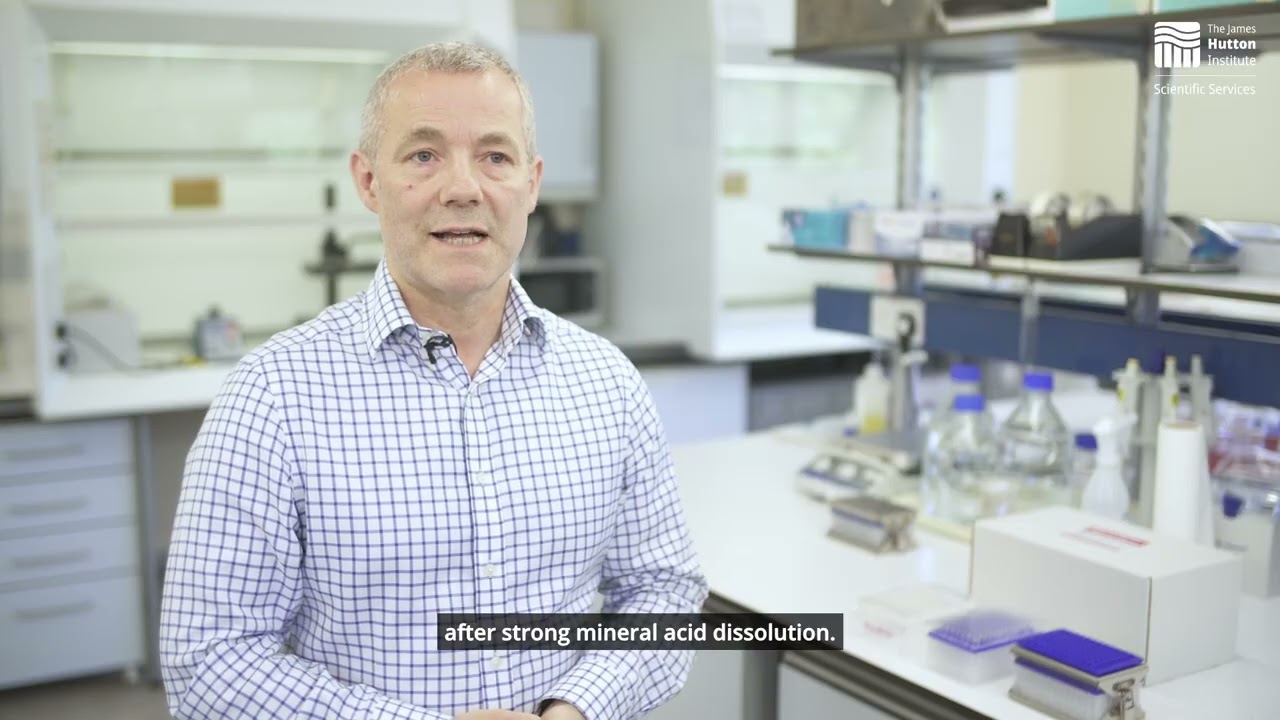
The soil analysis offered encompasses soil chemistry, physics, biology, and genomics and is well supported with technical and scientific expertise.
Jason Owen, Head of Technical Support Group
Soil Hydrology, Strength and Physics
Soil structure influences water and solute transportation through soils. Effecting fertiliser infiltration and run off from fields and thus point source and diffuse pollution of waterways and bodies. Soil physical analysis determines moisture retention using hanging water columns (HWC) and pressure plate (PP) apparatus, and strength, thus resilience to compaction and geotechnical attributes.
Soil Management, Health, DNA and Nematode Surveillance
Soil health has never been more important as we learn to adapt to a changing climate, loss of soil and changing land use. This requires a multidisciplinary approach ensuring our soils can support ecosystems and agricultural productivity. We offer a suite of services to define and determine a soil health, including DNA sequencing, metagenomics and nematode characterisation and surveillance, e.g. potato cyst nematode (PCP).
Soil analysis service for gardeners and growers
Healthy soil is the foundation of everything you grow. Hutton Scientific Services puts a century of soil science to work for farmers, gardeners and groundsmen, with accredited laboratory analysis to help you manage your soil effectively. Get started at huttonsoils.com
Soil health is closely linked to soil respiration and phospholipid fatty acid (PLFA) analysis (standard and 13C), as both indicate microbial activity and community composition, key drivers of nutrient cycling and ecosystem function, see our bespoke services.
For more information about our testing services from basic soil evaluation to in-depth investigation, research and interpretation, please contact us.
To learn more about this topic, visit the Regenerative Agriculture page.
Soil analysis measures the physical, chemical and biological properties of soil to assess its health and suitability for different land uses. Testing helps identify nutrient levels, soil structure, contaminants and organic matter, enabling better land management decisions for agriculture, environmental monitoring and sustainable land use. James Hutton Institute Scientific Services provides comprehensive soil analysis supported by over a century of research expertise.
James Hutton Institute Scientific Services offers a range of soil tests, including analysis of soil fertility, pH, electrical conductivity, nutrient levels, soil carbon, particle size distribution and potential contaminants such as heavy metals. Advanced analysis can also examine soil biology and microbial activity to provide deeper insights into soil health and ecosystem function.
Through services such as soil carbon and organic matter analysis, James Hutton Institute Scientific Services helps organisations understand soil’s role in carbon sequestration and ecosystem health. These insights support climate-smart agriculture, improved soil management and strategies that enhance resilience to environmental change.
Soil Carbon, Fertility, and Chemistry contact
Soil Health, DNA and Nematode Surveillance contact
Roy Neilson
Soil Ecologist
Based in Dundee
T: +44 (0)344 928 5428 (*)
Roy is a soil ecologist at the James Hutton Institute where he leads the Plant-Soil Interactions Research Group within the Ecological Sciences Departments and is the Hutton lead for the Centre for Agricultural Sustainable Innovation (CASI).
Soil Hydrology, Strength and Physics contact
Kenneth Loades
Research Leader
Based in Dundee
T: +44 (0)1382 568858
Soil is critical for food production but can often be poorly managed resulting in erosion and physical degradation. Research I perform ranges from soil stabilisation, physics, and root mechanics, to the development of tools and approaches for the quantification of soil condition. Understanding the services required of soil in the future, and soils ability to deliver these services, will be vital in managing soils to be resilient under changing environmental conditions.
My research also looks into furthering our fundamental understanding of root mechanical properties and what contributes to differences in the plant root properties allowing some species to thrive and others to struggle. Plant roots play a critical role in mechanically stabilising soil with both the roots of trees and finer root systems, such as grasses, having the potential to control and stabilise soil significantly.
Key to all reseach outputs is communication to those able to utilise knowledge gained from research. Knowledge transfer and exchange is something that I am passionate about which has led to representing soils and crops research within the SEFARI Gateway. As part of my research and SEFARI Gateway roles I regularly engage with stakeholders and policy departments to increase awareness of the most relevant ressearch findings.